
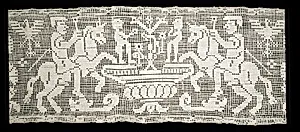
Border
Unknown Artist
17th century
Medium
Embroidered net, buratto
Dimensions
L. 33 x W. 7 1/2 inches 83.8 x 19.1 cm
Classification
Textiles-Laces
Culture
Italian
Department
European Sculpture and Decorative Arts
Museum
Metropolitan Museum of Art, New York, NY
Credit
The Nuttall Collection, Gift of Mrs. Magdalena Nuttall, 1908
Accession Number
08.180.665
Rights
Public Domain
Tags
Art Historical Context
This exquisite 17th-century Italian lace border, crafted from embroidered net known as *buratto*, exemplifies the intricate artistry of Baroque-era textiles. Measuring 33 by 7½ inches, it was likely used as a decorative trimming for garments, altar cloths, or furnishings, showcasing the period's fascination with delicate, ornamental lacework. Donated to The Metropolitan Museum of Art in1908 as part of The Nuttall Collection it resides in the European Sculpture and Decorative Arts department, Italy's pivotal role in lace production during the Renaissance and beyond. *Buratto* technique involved darning and embroidering designs onto a loosely woven square-mesh net ground with a needle, creating raised, sculptural patterns that mimicked woven fabrics. Here, the motif features horses—a symbol of nobility, speed, and vitality in 17th-century European iconography—rendered with remarkable precision and fluidity. This labor-intensive method required skilled artisans, often women, and reflected the era's blend of functionality and opulence in domestic luxury goods. As a rare surviving example of Italian *buratto*, this border offers a window into the cultural prestige of lace, traded across Europe and coveted by the elite. Its preservation invites us to appreciate the unseen hands behind these timeless threads, bridging fashion, faith, and fine art.