
Border
Unknown Artist
18th century
Medium
Bobbin lace
Dimensions
L. 64 1/2 x W. 3 1/8 inches 163.8 x 7.9 cm
Classification
Textiles-Laces
Culture
Dutch
Department
European Sculpture and Decorative Arts
Museum
Metropolitan Museum of Art, New York, NY
Credit
The Mabel Metcalf Fahnestock Collection, the gift of Ruth Fahnestock Schermerhorn and Faith Fahnestock, 1933
Accession Number
33.90.181
Rights
Public Domain
Art Historical Context
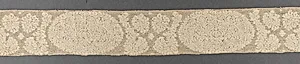
This delicate *Border* exemplifies the masterful craftsmanship of 18th-century Dutch bob lace, a pinnacle of European textile artistry. Stretching an impressive 64½ inches long and just 3⅛ inches wide, this narrow strip was likely designed as an edging for garments, linens, or furnishings, showcasing the era's obsession with ornate embellishment. Produced in the Netherlands, a historic center for lace production, it reflects the technical virtuosity required to weave fine linen threads into enduring patterns. Bobbin lace, distinct from needle lace, involves dozens of bobbins dangling from threads pinned to a cushion, allowing artisans—often women in specialized workshops—to twist, cross, and braid motifs with pinpoint precision. This labor-intensive technique demanded years of training and could take months for a piece of this length, highlighting lace's status as a luxury good traded across Europe. In Dutch culture, such laces symbolized wealth and refinement during the Enlightenment, adorning the elite amid the Republic's prosperous Golden Age legacy. Now part of the Metropolitan Museum of Art's European Sculpture and Decorative Arts collection, this border entered through the generous 1933 gift from The Mabel Metcalf Fahnestock Collection, preserving a tactile slice of vanished artisanal traditions for modern admirers.