
Border
1701/50
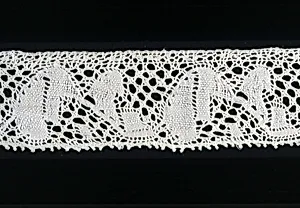
Medium
Linen, bobbin straight lace
Dimensions
4.9 × 19.7 cm (2 × 7 3/4 in.); Weft repeat: H.: 6.7 cm (2 5/8 in.)
Classification
textile
Department
Textiles
Museum
Art Institute of Chicago
Accession Number
38842
Rights
Public Domain
Art Historical Context
This delicate linen border, crafted between 1701 and 1750, exemplifies the exquisite artistry of bobbin straight lace, a technique popular in 17th- and 18th-century Europe. Measuring just 4.9 × 19.7 cm with a repeating weft pattern of 6.7 cm in height, it served as an elegant trimming for garments, linens, or furnishings. Bobbin lace, made by twisting and intertwining threads held on small bobbins over a patterned pillow, allowed lacemakers—often women in Flanders, Italy, or France—to create intricate, durable designs that mimicked needle lace's finesse but with greater efficiency for straight edges like this one. In the Baroque era, such lace borders symbolized wealth and refinement, adorning ruffs, cuffs, and altar cloths amid Europe's lace mania. Though the artist remains unknown, the piece reflects the anonymous mastery of guild-trained lacemakers, whose innovations in linear motifs and openwork elevated textiles to high art. Its preservation in the Art Institute of Chicago's Textiles Department highlights lace's role in bridging craft and culture, offering a tactile glimpse into daily opulence. Today, this modest yet masterful border invites us to appreciate the patience behind each precise knot, a testament to handmade luxury in a pre-industrial age.
About the Artist
Unknown
The artist designated as "Unknown" in our virtual museum's collection exemplifies a poignant chapter in art history: creators whose identities have faded into obscurity despite the enduring power of their work. With only one known artwork attributed to them in our holdings, this figure represents countless anonymous hands that shaped visual culture across centuries. Museums worldwide, including th...