
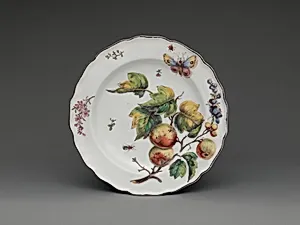
Botanical plate with spray of apples
ca. 1755
Medium
Soft-paste porcelain
Dimensions
Overall (confirmed): 1 5/16 × 9 × 9 in., 1 lb. (3.3 × 22.9 × 22.9 cm, 0.5 kg)
Classification
Ceramics-Porcelain
Culture
British, Chelsea
Department
European Sculpture and Decorative Arts
Museum
Metropolitan Museum of Art, New York, NY
Credit
Purchase, Larry and Ann Burns Gift, in honor of Austin B. Chinn, Tory Burch Gift, Caroline Burns Gift, in honor of Austin B. Chinn, Gift of Alexander Cochran Smith, by exchange, and funds from various donors, 2016
Accession Number
2016.224
Rights
Public Domain
Tags
Art Historical Context
This delicate botanical plate, produced by the Chelsea Porcelainufactory around 1755, exemplifies the height of early British porcelain artistry. Chelsea, one of England's pioneering porcelain factories established in the 1740s, in soft-paste porcelain European innovation blending clay with glass frit to mimic the prized hard-paste porcelain from China. Fired at lower temperatures, this medium allowed for intricate modeling and vibrant overglaze enameling making it ideal for tableware doubled as fine art. Adorned with a lush spray of apples and fluttering butterflies, the plate captures the Rococo era's love for naturalistic motifs, evoking abundance and the fleeting beauty of nature. Measuring just over 9 inches across, its shallow form and raised rim suggest use in a dessert service, where such vivid, hand-painted details would delight dinner guests. The butterflies add a whimsical touch, symbolizing transformation amid the ripe fruit. Chelsea porcelain's brief but brilliant output (1743–ca. 1770) influenced British decorative arts, blending technical virtuosity with elegant whimsy. Acquired by The Metropolitan Museum of Art in 2016 through generous gifts, this plate invites visitors to appreciate how 18th-century artisans transformed everyday objects into treasures of color and life.
About the Artist
Chelsea Porcelain Manufactory · 1744–1784
**Chelsea Porcelain Manufactory** The Chelsea Porcelain Manufactory, Britain's pioneering porcelain enterprise, was founded around 1743 in Chelsea, London, by two Huguenot silversmiths: Nicholas Sprimont from Liège and Charles Gouyn. Sprimont, trained in Paris as a goldsmith before immigrating to England, brought his expertise in luxury metalwork to the venture, while Gouyn handled early sales th...