
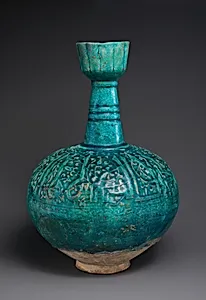
Bottle
Unknown Artist
late 11th–early 12th century
Medium
Thrown and molded in relief; earthenware
Dimensions
H. 13 5/8 in. (34.6 cm)
Classification
Ceramics
Department
Islamic Art
Museum
Metropolitan Museum of Art, New York, NY
Credit
Gift of Joan L. Simon, Elizabeth L. Eisenstein, Virginia L. Kahn, Dr. Marjorie G. Lewisohn, 1954
Accession Number
54.152.3
Rights
Public Domain
Art Historical Context
This elegant earthenware bottle, crafted in the late 11th to 12th century, hails from the vibrant world of Islamic, a period marked by innovative ceramic production across the Middle East and beyond. Standing at 13⅝ inches tall, it exemplifies the functional beauty of everyday vessels elevated to artistic heights. Now part of the Metropolitan Museum of's Islamic Art collection—thanks to a generous 1954 gift—this piece invites us to appreciate the ingenuity of anonymous artisans who transformed humble clay into sophisticated objects. The bottle was skillfully made using two key techniques: throwing on a potter's wheel for its graceful form and molding in relief for decorative elements. Earthenware, fired at lower temperatures than stoneware or porcelain, was ideal for this era's bold experimentation with textures and motifs, often featuring vegetal or geometric patterns that reflected Islamic aesthetic principles of harmony and repetition. These methods allowed for mass production while showcasing individual craftsmanship, blending utility with ornamentation. In a time when ceramics served as canvases for cultural exchange along Silk Road trade routes, this bottle whispers of bustling workshops and refined tastes. Though its maker remains unknown, it stands as a testament to the enduring legacy of Islamic pottery, bridging the practical and the poetic for generations of admirers.