
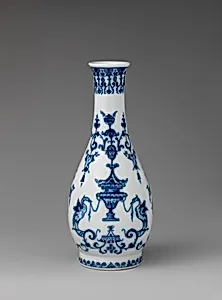
Bottle with arabesque designs (one of a pair)
ca. 1695–1700
Medium
Soft-paste porcelain
Dimensions
Height: 8 in. (20.3 cm)
Classification
Ceramics-Porcelain
Culture
French, Saint-Cloud
Department
European Sculpture and Decorative Arts
Museum
Metropolitan Museum of Art, New York, NY
Credit
Gift of J. Pierpont Morgan, 1917
Accession Number
17.190.1914
Rights
Public Domain
Tags
Art Historical Context
This delicate bottle, one of a matching pair produced by the Saint-Cloud factory around 1695–1700, exemplifies early French porcelain artistry. Standing 8 inches (20.3 cm) tall, it is crafted from soft-paste porcelain—a European innovation blending clay, ground glass, and other materials fired at lower temperatures than Chinese hard-paste porcelain. surface blooms with intricate arabesque designs featuring scrolling vines and lively birds, likely rendered in the factory's signature blue-under-glaze technique for a subtle, enduring elegance. During Louis XIV's reign, France vied to rival Chinese imports, fueling secret porcelain experiments. Saint-Cloud, established in the 1670s near Paris, became a leader in soft-paste production, creating luxurious tableware and decorative objects for the aristocracy. These bottles, with their rhythmic arabesques inspired by Eastern motifs yet infused with French refinement, highlight the era's cultural fusion and technical prowess. A gift from J. Pierpont Morgan in 1917, this piece resides in the Metropolitan Museum of Art's European Sculpture and Decorative Arts collection, offering a glimpse into the dawn of France's porcelain golden age.
About the Artist
Saint-Cloud factory · 1693–1766
The Saint-Cloud porcelain factory, situated on the Seine in the town of Saint-Cloud near Paris, revolutionized European ceramics as the first to manufacture soft-paste porcelain commercially, beginning in 1693. Originally established around 1664-1666 as a faience workshop, it shifted to porcelain under Pierre Chicaneau, a potter whose experiments yielded a frit-based paste with a warm yellowish or...