
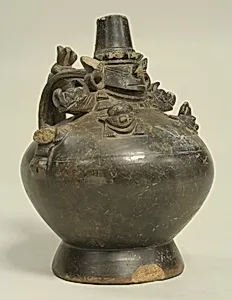
Bottle with Figures
Unknown Artist
9th–11th century
Medium
Ceramic
Dimensions
H. 7 5/8 in. (19.4 cm)
Classification
Ceramics-Containers
Culture
Lambayeque (Sicán)
Department
Arts of Africa, Oceania, and the Americas
Museum
Metropolitan Museum of Art, New York, NY
Credit
Gift of Mr. and Mrs. Jack Davis Neal, 1970
Accession Number
1970.245.36
Rights
Public Domain
Tags
Art Historical Context
This exquisite ceramic bottle, crafted by an unknown artist of the Lambayeque (Sicán) culture on Peru's north coast between the 9th and 11th centuries, stands as a testament to the region's masterful pre-Columbian pottery traditions. Measuring just 7⅝ inches tall, it belongs to the iconic Andean vessel form often used for liquids, blending functionality with artistry. The Lambayeque people, who thrived in the Lambayeque Valley amid fertile coastal lands, produced such ceramics as grave goods or ritual objects, reflecting their complex society influenced by earlier Moche styles. Adorned with modeled human figures—likely representing elites, deities, or mythological beings—the bottle showcases the Sicán artisans' skill in low-relief modeling and slip decoration. These techniques allowed for vivid storytelling on clay surfaces fired at high temperatures for durability. Ceramics like this were central to Lambayeque culture, symbolizing status, cosmology, and daily life, and often placed in elite tombs alongside gold and silver treasures. Today, this gift to the Metropolitan Museum of Art from Mr. and Mrs. Jack Davis Neal in 1970 invites us to marvel at the ingenuity of ancient Peruvian potters, whose works continue to reveal the spiritual and social world of the Sicán.