
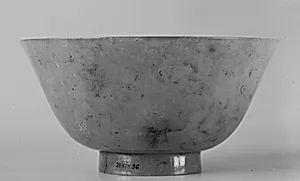
Bowl
Unknown Artist
18th century
Medium
Jadeite
Dimensions
H. 2 7/8 in. (7.3 cm); W. 5 3/4 in. (14.6 cm)
Classification
Jade
Culture & Period
China · Qing dynasty (1644–1911)
Department
Asian Art
Museum
Metropolitan Museum of Art, New York, NY
Credit
Bequest of Edmund C. Converse, 1921
Accession Number
21.175.96
Rights
Public Domain
Art Historical Context
This elegant jadeite bowl, crafted in 18th-century China during Qing dynasty (16441911), exemplifies the's mastery of luxury craftsmanship. Measuring just 2⅞ inches high and 5¾ inches wide, its compact form suggests it was designed for refined use—perhaps as a scholarly inkstone holder or a vessel for precious elixirs among the elite. Jadeite, a vivid green variety of jade rarer than the more common nephrite, was highly prized for its translucency and durability, symbolizing purity, immortality, and imperial virtue in Chinese culture. Qing artisans honed jade carving to perfection, employing intricate techniques like incising, drilling, and polishing to reveal the stone's natural luster without waste. This bowl's smooth contours and subtle sheen reflect that skill, transforming a humble object into a status symbol. Jade vessels like this were not merely functional; they embodied Confucian ideals of harmony and refinement, often gifted to scholars or displayed in imperial collections. Today, housed in the Metropolitan Museum of Art's Asian Art Department through the 1921 bequest of Edmund C. Converse, this anonymous masterpiece invites us to appreciate the Qing dynasty's blend of artistry and philosophy. Gaze closely, and you'll sense the stone's cool, eternal whisper of ancient elegance.