
Bowl
Unknown Artist
probably 11th century
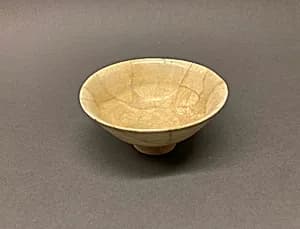
Medium
Stonepaste; carved, transparent greenish glaze
Dimensions
H. 2 in. (5.1 cm) Diam. 4 1/16 in. (10.3 cm)
Classification
Ceramics
Department
Islamic Art
Museum
Metropolitan Museum of Art, New York, NY
Credit
Rogers Fund, 1938
Accession Number
38.40.177
Rights
Public Domain
Art Historical Context
This delicate stonepaste bowl, likely crafted in the 11th, exemplifies the ingenuity of Islamic ceramic artisans during a golden age of innovation. Measuring just 2 inches high 4 inches in diameter, its petite form was ideal for serving sweets, fruits, or beverages in elite households across the Islamic world, from Persia to Egypt. The transparent greenish glaze imparts a luminous, jewel-like quality, evoking the natural hues of turquoise or emerald—colors revered in Islamic art for their symbolic ties to paradise gardens. Stonepaste, a composite of quartz, clay, and glass frit, was a revolutionary medium developed by Islamic potters around the 10th-11th centuries to imitate the translucent purity of Chinese porcelain, which was unavailable locally. Here, the surface bears intricate carved designs—subtle incisions made before glazing and firing—creating textured patterns that catch the light beneath the glossy finish. This labor-intensive technique highlights the technical mastery and aesthetic refinement of the era, bridging utility and artistry in everyday objects. Housed in the Metropolitan Museum of Art's Islamic Art Department (acquired via the Rogers Fund in 1938), this anonymous masterpiece invites us to appreciate how ceramics became canvases for cultural expression, blending functionality with poetic beauty in medieval Islamic society.