
Bowl
Unknown Artist
12th century
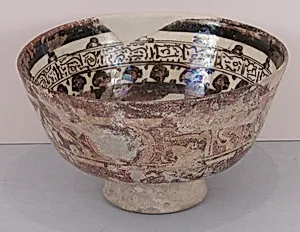
Medium
Stonepaste; painted in luster and blue on opaque white glaze under transparent colorless glaze
Dimensions
H. 4 1/2 in. (11.4 cm) Diam. 8 1/16 in. (20.5 cm)
Classification
Ceramics
Department
Islamic Art
Museum
Metropolitan Museum of Art, New York, NY
Credit
H.O. Havemeyer Collection, Gift of Horace Havemeyer, 1948
Accession Number
48.113.7
Rights
Public Domain
Art Historical Context
This elegant 12th-century stonepaste bowl, hailing from the Islamic world, exemplifies the pinnacle of ceramic innovation. Crafted with an opaque white glaze as its base, it is adorned with intricate paintings in shimmering luster—a metallic gold-toned pigment—and vibrant blue, all sealed under a transparent colorless glaze. Measuring just 4½ inches high and 8 in diameter, its shallow, wide form was ideal for serving fruits, sweets, or beverages in affluent households, blending functionality with artistry. Stonepaste, a composite of quartz, clay, and glass frit, was a revolutionary Islamic invention around the 10th century, allowing potters to mimic the delicacy of Chinese porcelain while enabling bold underglaze decoration. The luster technique, originating in 9th-century Iraq and flourishing in Iran and Syria by the 12th century, created an iridescent glow through firing in a reducing atmosphere, evoking precious metals. This bowl's dual-color palette highlights the era's mastery of chemistry and design, often featuring geometric motifs or floral patterns symbolizing paradise gardens in Islamic culture. Now part of the Metropolitan Museum of Art's renowned Islamic Art collection—gifted in 1948 from the H.O. Havemeyer Collection—this anonymous masterpiece invites us to marvel at the ingenuity of artisans whose techniques influenced ceramics across Eurasia for centuries.