
Bowl
Unknown Artist
12th century
Medium
Stonepaste; overglaze painted, so-called "mina'i" ware
Dimensions
H. 2 1/8 in. (5.4 cm) Diam. 8 3/16 in. (20.8 cm)
Classification
Ceramics
Department
Islamic Art
Museum
Metropolitan Museum of Art, New York, NY
Credit
The Milton A. Rauh and Florence L. Goldmark Collection, Bequest of Florence L. Goldmark, 1974
Accession Number
1974.161.5
Rights
Public Domain
Tags
Art Historical Context
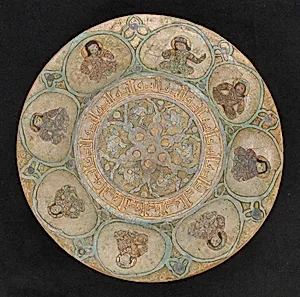
This exquisite 12th-century stonepaste bowl, a prime example of so-called "mina'i" from the Islamic world, hails from the Metropolitan Museum of Art's Islamic Art collection. Measuring just over 2 inches tall and8 inches across, its shallow form was ideal for serving fruits, sweets, or in affluent households. Crafted anonymously by a skilled potter—likely in Iran during the Seljuq era—this ceramic masterpiece showcases the era's technical brilliance, with a durable stonepaste body (fritware) that mimicked porcelain's finesse. The bowl's standout feature is its overglaze painting technique, where colors like cobalt blue, turquoise, and gold were fired onto a glazed surface at lower temperatures, yielding luminous, enamel-like effects. This innovative "mina'i" method, peaking around Kashan in the 12th century, allowed for intricate designs often featuring human figures—here hinted at through lively courtly scenes or daily life motifs. Such vivid, multi-layered decoration marked a high point in Persian ceramics, blending artistry with luxury. Culturally, these bowls reflect Seljuq prosperity and a taste for secular themes, where human figures danced, hunted, or reveled despite broader Islamic aniconic traditions. Donated through the Milton A. Rauh and Florence L. Goldmark Collection in 1974, it invites us to savor the vibrancy of medieval Islamic ingenuity.