
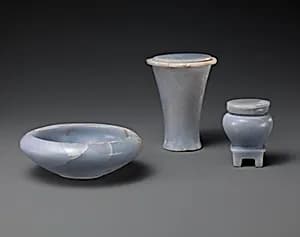
Bowl
Unknown Artist
ca. 1878–1749 B.C.
Medium
Anhydrite
Dimensions
H. 3.4 cm (1 5/16 in.); Diam. 9.7 cm (3 13/16 in.)
Classification
Bowl
Period
Middle Kingdom
Department
Egyptian Art
Museum
Metropolitan Museum of Art, New York, NY
Credit
Gift of Egypt Exploration Fund, 1904
Accession Number
04.18.49
Rights
Public Domain
Art Historical Context
This delicate bowl, crafted around 1878–1749 B.C. during Egypt's Middle Kingdom (late Dynasty to early Dynasty 13), the refined artistry of ancient Egyptian stoneworkers. Measuring just 3.4 cm high and 9.7 cm in diameter, its shallow, open form was ideal for holding precious oils, cosmetics, or ritual offerings—items central to daily life and religious practices in a period of political stability and cultural flourishing. Carved from anhydrite, a fine-grained variety of gypsum often revered as "Egyptian alabaster," the vessel showcases the material's prized translucency and workability. Artisans likely used lathes or hand tools to achieve its smooth, polished surface, highlighting technical mastery without ostentation. Such bowls were status symbols, blending utility with subtle elegance in elite households or temples. Acquired through the Egypt Exploration Fund's efforts and gifted to the Metropolitan Museum of Art in 1904, this anonymous masterpiece offers a tangible glimpse into Middle Kingdom ingenuity, where everyday objects embodied enduring aesthetic ideals.