
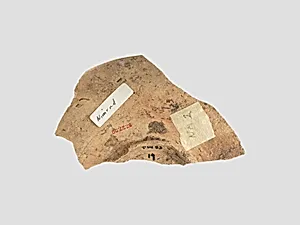
Bowl sherd
Unknown Artist
ca. 8th–7th century BCE
Medium
Ceramic
Dimensions
0.2 x 4.76 in. (0.51 x 12.09 cm)
Classification
Ceramics-Vessels
Culture & Period
Assyrian · Neo-Assyrian
Department
Ancient Near Eastern Art
Museum
Metropolitan Museum of Art, New York, NY
Credit
Rogers Fund, 1957
Accession Number
57.27.52
Rights
Public Domain
Art Historical Context
This delicate ceramic bowl sherd offers a tangible glimpse into the life of the Neo-Assrian Empire, one of ancient Near East's most powers from around 911 609 BCE. Dating the 8th–th century BCE, this fragment—measuring 0.2 x4.76 inches— originated from a simple household vessel used for serving food liquids in bustling Assyrian cities Nineveh or Assur. Acquired through the Rogers Fund in 1957, it resides in the Metropolitan Museum of's Ancient Near Eastern Art, exemplifying the enduring legacy of Assyrian craftsmanship. Neo-Assyrian ceramics were wheel-thrown and fired in kilns, showcasing practical artistry amid an era of monumental palace reliefs and military conquests under kings like Sennacherib and Ashurbanipal. Though incomplete, this sherd highlights the empire's sophisticated pottery production, essential for sustaining urban populations and trade networks stretching from Mesopotamia to the Levant. Its survival underscores the archaeological value of such fragments, which archaeologists piece together to reconstruct ancient vessels and infer cultural practices. For museum visitors, this unassuming piece bridges the gap between grand imperial narratives and everyday existence, reminding us that even the smallest artifacts carry the weight of history.