
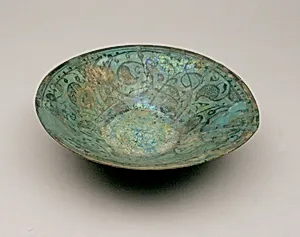
Bowl wih Vegetal Decoration
13th/14th century
Medium
Fritware painted in black under a transparent turquoise glaze
Dimensions
8 × 33.1 cm (3 3/16 × 13 1/16 in.)
Classification
ceramics
Department
Arts of Asia
Museum
Art Institute of Chicago
Accession Number
10830
Rights
Public Domain
Art Historical Context
This exquisite *Bowl with Vegetal Decoration*, crafted in the 13th or 14th century, the pinnacle of Islamic ceramic artistry from the medieval Islamic world, likely Persia (modern-day Iran). Made of fritware—a composite of quartz, clay, and frit that mimicked the translucency of coveted Chinese porcelain—this shallow bowl (8 × 33.1 cm) features black-painted motifs of lush foliage and floral scrolls under a vibrant turquoise glaze. The turquoise hue, achieved through copper oxide, was a hallmark of Kashan workshops during the Ilkhanid period, blending technical innovation with aesthetic splendor. Fritware emerged around the 12th century as Islamic potters adapted to local materials, producing durable yet finely potted vessels superior to earlier earthenware. The underglaze painting technique ensured the designs remained sharp and unfaded, even after centuries, showcasing mastery over kilns reaching over 1,000°C. Vegetal motifs, rooted in Islamic aesthetics, evoked paradise gardens from the Quran, adhering to aniconic traditions that favored abstract nature over figurative forms. Housed in the Art Institute of Chicago's Arts of Asia department, this bowl not only served practical purposes like serving fruits or sweets but also symbolized cultural exchange along the Silk Road. Its enduring turquoise glow invites visitors to appreciate how Islamic artisans transformed everyday objects into poetic celebrations of beauty and ingenuity.
About the Artist
Islamic
Islamic art, a profound visual tradition originating in the 7th century CE, flourished across vast territories from Spain to India under Muslim rule, encompassing architecture, ceramics, manuscripts, textiles, and metalwork produced by diverse artisans rather than a single named master. Drawing from pre-Islamic Sasanian, Byzantine, and late antique influences, its early development under the Umayy...