
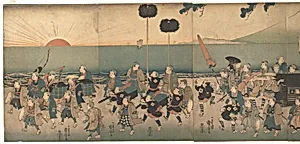
Boys Play-acting a Daimyo Procession
19th century
Medium
Pentaptych of woodblock prints; ink and color on paper
Dimensions
14 5/8 x 50 in. (37.1 x 127 cm)
Classification
Prints
Culture & Period
Japan · Edo period (1615–1868)
Department
Asian Art
Museum
Metropolitan Museum of Art, New York, NY
Credit
H. O. Havemeyer Collection, Bequest of Mrs. H. O. Havemeyer, 1929
Accession Number
JP1806a–e
Rights
Public Domain
Tags
Art Historical Context
In the vibrant world of 19th-century Japan, Utagawa Kuniyoshi captures a moment of pure childhood delight in *Boys Play-acting a Daimyo Procession*, a pentaptych woodblock print from the Edo period (1615–1868). This five-panel composition unfolds a panoramic scene of young boys joyfully mimicking the grand procession of a daimyo—a powerful feudal lord—complete with tiny banners, palanquins, and playful costumes under a bright sun. Kuniyoshi, a master of the ukiyo-e tradition, infuses the work with his signature humor and dynamic energy, blending everyday life with theatrical flair. Woodblock printing, using ink and color on paper, was the era's revolutionary medium, allowing affordable mass production and vivid storytelling. The pentaptych format (14 5/8 x 50 in.) creates an immersive, scrolling vista, evoking the lively street festivals and kabuki influences of urban Edo (modern Tokyo). These prints celebrated the "floating world" of fleeting pleasures, offering a whimsical contrast to the rigid hierarchies of samurai society. Part of the Metropolitan Museum of Art's H. O. Havemeyer Collection, this piece highlights Kuniyoshi's versatility beyond his famous warrior prints, inviting us to smile at the timeless innocence of play amid Japan's rich cultural tapestry.
About the Artist
Utagawa Kuniyoshi · 1797–1861
Utagawa Kuniyoshi (1797–1861) was born in Edo to the silk-dyer Yanagiya Kichiyemon, originally bearing the childhood name Yoshisaburō. From a young age, he assisted in his family's pattern design work, which sharpened his innate mastery of color and textile motifs that would permeate his later prints. At around twelve years old, his prodigious drawing skills drew the attention of the renowned Utag...