
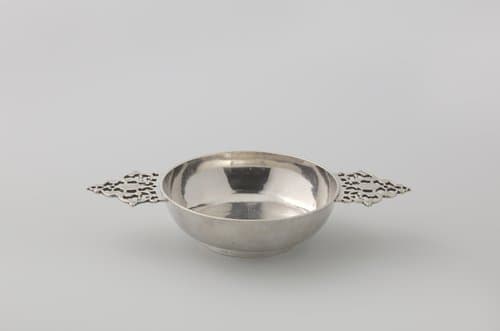
Brandewijnskom van zilver op lage, ronde, onversierde cuppa met twee horizontale uitgezaagde oren. Vals.
1746
Medium
silver (metal)
Dimensions
4; 11.8; 21.5
Rights
Public Domain
About this artwork
Brandewijnkom van zilver. Lage, ronde onversierde cuppa met twee horizontale oren, bestaande uit gezaagd, symmetrisch bandornament.
Art Historical Context
This elegant silver brandy bowl, crafted by Dutch silversmith Jan Verdoes in 1746, exemplifies the refined metalwork traditions of 18th-century Europe. Measuring just 4 cm high with a diameter of 11.8 cm, the compact vessel features a low, round, and unadorned cuppa paired with two horizontal “ears” formed from delicately sawn, symmetrical band ornament. Such bowls were used for serving brandy at social gatherings, where their modest scale encouraged intimate, shared moments around the table. The medium of silver highlights both the object’s functional purpose and its status as a luxury item. Verdoes employed precise sawing techniques to create the openwork handles, balancing practicality with subtle decorative interest. Despite the plain cuppa, the contrast between smooth surfaces and pierced ornament demonstrates the silversmith’s skill in achieving elegance through restraint. As a surviving example of mid-18th-century Dutch silverware, the bowl offers visitors a glimpse into everyday refinement and the high standards of period craftsmanship. Its compact form and thoughtful detailing continue to speak to the enduring appeal of objects made for both use and quiet admiration.