
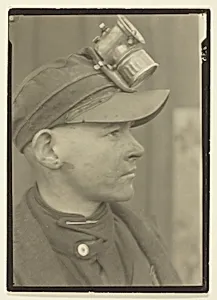
Breaker Boy in Pennsylvania Coal Mine
Medium
Gelatin silver print
Dimensions
16.8 × 11.8 cm (6 5/8 × 4 11/16 in.)
Classification
gelatin silver (developing-out-paper) pr
Department
Photography and Media
Museum
Art Institute of Chicago
Accession Number
23224
Rights
Public Domain
Art Historical Context
Lewis Wickes Hine’s 1915 gelatin silver print, Breaker Boy in Pennsylvania Coal Mine, presents a poignant image of a young worker in the coal industry. This compact photograph, 16.8 by 11.8 centimeters and housed at the Art Institute of Chicago, captures the essence of child labor in early 20th-century America through Hine’s documentary lens. Hine was a pioneering photographer who focused on social issues, using his camera to document the lives of working children. Breaker boys were youngsters employed in Pennsylvania coal mines to separate coal from rock and debris, a dangerous and dirty job that highlighted the era’s industrial demands on society’s youngest members. His work brought these hidden realities to public attention, underscoring the need for labor reforms. The gelatin silver process, a developing-out-paper technique standard at the time, produced high-quality black-and-white images with fine detail and contrast that emphasized the subject’s expression and environment. This artwork serves as both a historical document and an artistic statement on the human cost of progress, inviting viewers to reflect on social justice and photography’s role in advocacy.
About the Artist
Lewis Wickes Hine · 1874–1940
Lewis Wickes Hine (1874–1940) was born on September 26 in Oshkosh, Wisconsin, to Douglas and Sarah Hine, who ran a coffeehouse and restaurant on Main Street. After his father's accidental death from a self-inflicted gunshot wound around 1892, the teenage Hine supported his widowed mother and sisters through various jobs while pursuing education. He attended Oshkosh Normal School, where he met ment...