
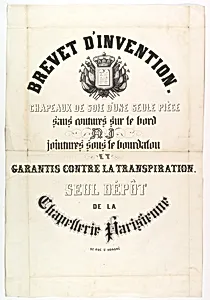
Brevet d'Invention. Chapeaux de soie d'une seule pièce...
19th century
Medium
Wood engraving
Dimensions
Sheet: 20 7/8 x 14 1/8 in. (53 x 35.8 cm)
Classification
Prints
Department
Drawings and Prints
Museum
Metropolitan Museum of Art, New York, NY
Credit
Gift of Bella C. Landauer, 1925
Accession Number
26.28.159
Rights
Public Domain
Art Historical Context
Step into the inventive spirit of 19th-century with *Brevet d'Invention. Chapeaux de soie d seule pièce* (Patent Invention: One-Piece Silk Hats), anonymous wood engraving from the Metropolitan Museum of Art's Drawings and Prints collection. large sheet, measuring 20 7/8 x 14 1/8 inches, captures the technical diagrams and details of a patented innovation in hat-making, showcasing how silk could be formed into seamless top hats—a staple of Victorian-era fashion for the elite. Wood engraving, a hallmark of 19th-century printmaking, allowed for precise, durable illustrations that could be mass-produced alongside text in books and official documents. End-grained wood blocks enabled fine lines and intricate shading, making it ideal for patents that required clear, reproducible visuals of mechanical processes. This technique democratized technical knowledge during the Industrial Revolution, bridging art and industry. Culturally, the print reflects France's booming fashion and manufacturing sectors, where top hats symbolized status and sophistication. Donated to the Met in 1925 by Bella C. Landauer, it preserves a slice of everyday innovation, reminding us how everyday objects like hats drove creativity and commerce in a transformative era.
About the Artist
Anonymous, French, 19th century · 1800–1900
**Anonymous, French, 19th Century (ca. 1800–1900)** The artist cataloged as Anonymous, French, 19th century embodies the enigmatic yet essential contributions of unidentified creators to France's vibrant 19th-century art world. Active roughly between 1800 and 1900, this figure—or potentially collective workshop—produced a diverse array of works amid the nation's transition from Neoclassicism thro...