
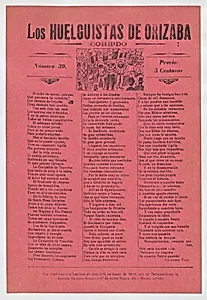
Broadsheet relating to a worker's strike in Orizaba, workers holding up the Mexican flag, flanked by soldiers
1920 (published)
Medium
Zincograph and letterpress on pink paper
Dimensions
Sheet: 11 5/8 × 7 7/8 in. (29.5 × 20 cm)
Classification
Prints
Department
Drawings and Prints
Museum
Metropolitan Museum of Art, New York, NY
Credit
The Elisha Whittelsey Collection, The Elisha Whittelsey Fund, 1946
Accession Number
46.46.161
Rights
Public Domain
Tags
Art Historical Context
This striking 1920 broadsheet, created by the renowned Mexican printmaker José Guadalupe Posada collaboration with publisher Antonio Van Arroyo, captures a pivotal moment of labor unrest: workers in Orizaba proudly hoist the Mexican flag, flanked by soldiers. Produced as a zincograph and letterpress vibrant pink paper (measuring 11 5/8 × 7 7/8 in.), it exemplifies the affordable, mass-produced prints that brought news and social commentary to everyday people during Mexico's turbulent post-Revolutionary era. Printed just after the Mexican Revolution (1910–1920), the image reflects the era's intense labor struggles, including strikes in industrial centers like Orizaba, a hub for textiles and railroads. Posada, a master of satirical broadsheets, often depicted calaveras (skeletons) and everyday heroism to critique power and champion the working class. Here, the composition blends national pride with military presence, hinting at fragile alliances between strikers and authorities amid demands for workers' rights. Zincography, a zinc-plate lithographic technique, allowed for sharp details and bold colors on inexpensive paper, making it ideal for corridos (ballads) and flyers circulated in markets. Housed in the Metropolitan Museum of Art's Drawings and Prints department, this piece highlights Posada's enduring influence on Mexican graphic arts, bridging folk tradition and political activism.
About the Artist
José Guadalupe Posada|Antonio Vanegas Arroyo · 1852–1913
José Guadalupe Posada (1852-1913) was a Mexican printmaker and engraver who revolutionized popular art and created some of the most iconic images in Mexican culture. Working primarily with publisher Antonio Vanegas Arroyo, he produced over 20,000 images during his career—inexpensive broadsheets sold for a penny on colored paper that made his art accessible to even the poorest workers. He transform...