
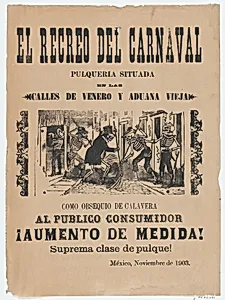
Broadsheet relating to carnival and the sale of high quality Pulque
Medium
Type-metal engraving and letterpress on tan paper
Dimensions
Sheet: 16 1/8 in. × 12 in. (41 × 30.5 cm)
Classification
Prints
Department
Drawings and Prints
Museum
Metropolitan Museum of Art, New York, NY
Credit
The Elisha Whittelsey Collection, The Elisha Whittelsey Fund, 1946
Accession Number
46.46.281
Rights
Public Domain
Tags
Art Historical Context
This vibrant 1903 broadsheet, produced by publisher Antonio Vanegas Arroyo with illustrations by the legendary José Guadalupe Posada, celebrates's lively carnival season while promoting high-quality pulque—a traditional, frothy alcoholic beverage made from the maguey plant. Printed on tan paper via type-metal engraving and letter, the sheet measures 16⅛ × 12 inches and features Posada's iconic skeletons, or *calaveras*, dancing reveling amid festive scenes. These skeletal figures, a hallmark of Posada's oeuvre, blend humor with the macabre, echoing Mexico's Day of the Dead traditions and medieval European *danse macabre* motifs. During Mexico's Porfiriato era under President Porfirio Díaz, such affordable broadsheets (*hojas volantes*) were ubiquitous street literature, disseminating news, satire, and advertisements to the working class. Posada's stark, bold engravings critiqued social vanities—here, perhaps poking fun at carnival excess and pulque's popularity among laborers—while capturing the era's cultural pulse. His zincographic techniques allowed mass production, making art accessible beyond elite circles. Today, housed in the Metropolitan Museum of Art's Drawings and Prints department as part of The Elisha Whittelsey Collection, this piece exemplifies Posada's enduring influence on Mexican graphic arts, foreshadowing the satirical prints of the Mexican Revolution and modern *calavera* poetry by figures like Octavio Paz. A window into early 20th-century popular culture!