
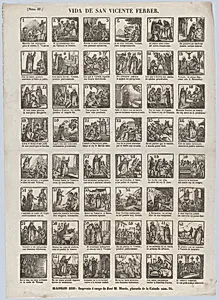
Broadside with 48 scenes relating to the life of St Vincent Ferrer
1858
Medium
Wood engraving
Dimensions
Sheet: 17 1/8 × 12 5/16 in. (43.5 × 31.3 cm)
Classification
Prints
Department
Drawings and Prints
Museum
Metropolitan Museum of Art, New York, NY
Credit
Max G. Wildnauer Fund, 1978
Accession Number
1978.643.47(2)
Rights
Public Domain
Tags
Art Historical Context
This intricate wood engraving by Spanish artist José María Marés created in 1858, is a devotional broadside featuring 48 vivid scenes from the life of St. Vincent Ferrer, the 14th-century Dominican preacher renowned for his fiery sermons on repentance and miraculous healings. Printed on a single sheet measuring about 17 by 12 inches, it key moments from the saint's missionary journeys across Europe, including conversions, resurrections, and encounters with everyday men and women, reflecting his enduring popularity in Catholic Spain. Broadside prints like this were a staple of 19th-century religious culture, serving as affordable, wall-mounted aids for private devotion and education in homes and churches. Amid Spain's mid-1800s Catholic revival, such works popularized hagiographies—saints' lives—to inspire faith amid social upheaval. St. Vincent Ferrer, canonized in 1455, symbolized divine intervention, making this piece both a storytelling marvel and a tool for spiritual reflection. Marés's mastery of wood engraving shines in the fine, detailed vignettes packed into a compact format, a technique that allowed precise lines and textures on wood's end grain for mass production. Housed in the Metropolitan Museum of Art's Drawings and Prints department, this rare survivor highlights the artistry of ephemeral religious prints.
About the Artist
José María Marés · 1850–1870
José María Marés was a Spanish printer, publisher, and broadside producer active in Madrid from approximately 1850 to 1870. Operating first from addresses on the Calle de Relatores and later from the Plazuela de la Cebada under the imprint Imprenta de Marés y Compañía, he ran one of the more prolific popular-print establishments in mid-nineteenth-century Madrid. His presses produced illustrated br...