
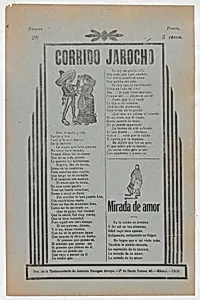
Broadside with two love ballads (corridos), figures dancing upper left and a woman wearing a shawl and skirt lower right
ca. 1918 (published)
Medium
Type-metal engraving and letterpress on blue paper
Dimensions
Sheet: 12 in. × 7 3/4 in. (30.5 × 19.7 cm)
Classification
Prints
Department
Drawings and Prints
Museum
Metropolitan Museum of Art, New York, NY
Credit
The Elisha Whittelsey Collection, The Elisha Whittelsey Fund, 1946
Accession Number
46.46.194
Rights
Public Domain
Tags
Art Historical Context
This vibrant broadside, printed around 1918 by publisher Antonio Vanegas Arroyo with illustrations by the legendary Mexican artist José Guadalupe Pos, captures the lively spirit of popular Mexican culture through two love ballads known as *corridos*. These narrative folk songs, often sung and shared among the working class, tell tales of romance, adventure, and everyday drama. The composition features energetic dancers in the upper left, evoking festive revelry, contrasted with a poised woman in a shawl and skirt below right—hallmarks of traditional Mexican attire that ground the scene in rural life. Posada, a master of satirical and socially observant prints, was renowned for his bold, black-line style during Mexico's turbulent revolutionary era (1910–1920). Working with Arroyo, he produced affordable broadsides like this one, sold on street corners to educate and entertain the masses. The use of type-metal engraving and letterpress on striking blue paper created vivid contrasts and durability, making it ideal for mass distribution. This technique democratized art, blending text and image to illustrate *corridos* visually. Housed in the Metropolitan Museum of Art's Drawings and Prints department, this piece exemplifies Posada's enduring influence on Mexican graphic arts and his role in preserving cultural storytelling. Visitors will appreciate how it bridges folk tradition with revolutionary fervor, offering a window into early 20th-century Mexico's vibrant street life.