
Broche
ca. 1820 - ca. 1840
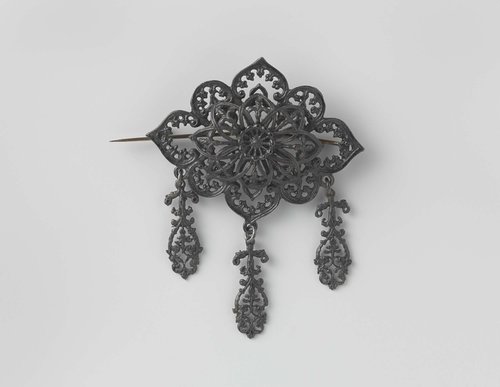
Medium
casting
Dimensions
6; 5.5
Rights
Public Domain
About this artwork
gezwart ijzer
Art Historical Context
### Broche (ca. 1820–1840) This delicate brooch, measuring just 6 cm long by 5.5 cm wide, exemplifies early 19th-century jewelry craftsmanship through its use of cast blackened iron ("gezwart ijzer" in Dutch). Created anonymously during a period of industrial innovation, the piece likely features intricate filigree or neoclassical motifs typical of the era, achieved via precise casting techniques. Iron, hardened and patinated to a deep, lustrous black, offered an affordable alternative to precious metals, making fine jewelry accessible beyond the elite. Historically, blackened iron jewelry surged in popularity around 1820–1840, particularly in Europe amid post-Napoleonic recovery. In Prussia and the Netherlands, it symbolized patriotism and economy—women traded gold for iron pieces to fund wars, sparking a "Berlin iron" style known for its lightweight, ornate designs. The casting process, involving molds for detailed openwork, highlighted emerging industrial artistry, blending hand-finishing with machine precision. Though small, this brooch carries cultural weight as a wearable artifact of resilience and style. Its enduring patina whispers of daily adornment, inviting us to imagine it pinned to a lace collar during Biedermeier gatherings—elegant proof that beauty thrived in humble materials.
About the Artist
anonymous
In the vast tapestry of art history, "Anonymous" stands not as a singular individual but as a collective designation for countless unidentified creators whose works have endured across millennia. These artists, spanning prehistoric cave painters to medieval illuminators and folk craftsmen, produced the foundational layers of human visual culture. Prior to the Renaissance, when individual fame emer...