
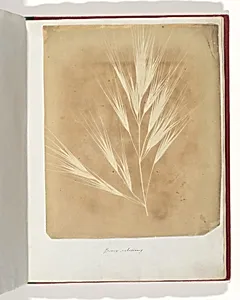
Bromus Maximus, Genoa
Medium
Salted paper print
Dimensions
22.5 x 18.8 cm (8 7/8 x 7 3/8 in.), irregularly trimmed
Classification
Photographs
Department
Photographs
Museum
Metropolitan Museum of Art, New York, NY
Credit
Harris Brisbane Dick Fund, 1936
Accession Number
36.37 (3)
Rights
Public Domain
Tags
Art Historical Context
Step into the dawn of photography with *Bromus Maximus, Genoa* (1839), a delicate salted paper print by William Henry Fox Talbot. This 22.5 x 18.8 cm image captures a specimen of Bromus maximus—a towering wild grass from Genoa, Italy—its feathery seed heads rendered with astonishing clarity against a soft, warm-toned background. Talbot, a British inventor and scholar, created this irregularly trimmed print as part of his pioneering experiments, showcasing nature's intricate details through light alone. As one of the earliest surviving photographs, it dates to 1839, the very year Talbot publicly unveiled his "photogenic drawing" process, a direct rival to Louis Daguerre's daguerreotype. The salted paper print technique involved coating paper with salt and silver nitrate, then exposing it to sunlight with the object in place—a contact print method that produced subtle, painterly tones without a camera lens in some cases. This innovation laid the groundwork for modern negative-positive printing, making photography reproducible and accessible. Housed in The Metropolitan Museum of Art's Photographs Department (Harris Brisbane Dick Fund, 1936), *Bromus Maximus* highlights photography's potential as a scientific tool for botany, bridging art and empirical observation. Its humble, organic edges evoke the raw excitement of discovery, inviting us to marvel at how a simple blade of grass helped birth an enduring visual revolution.
About the Artist
William Henry Fox Talbot · 1800–1877
William Henry Fox Talbot (1800–1877), a British polymath whose ingenuity transformed visual representation, was born on 11 February 1800 at Melbury House, Dorset, the only child of William Davenport Talbot of Lacock Abbey and Lady Elisabeth Fox Strangways, daughter of the 2nd Earl of Ilchester. His father died shortly after his birth, leaving the family in financial straits until his formidable mo...