
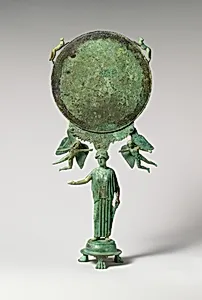
Bronze mirror with a support in the form of a draped woman
Unknown Artist
mid-5th century BCE
Medium
Bronze
Dimensions
H. 12 5/8", Diameter 5 3/8"
Classification
Bronzes
Culture & Period
Greek · Classical
Department
Greek and Roman Art
Museum
Metropolitan Museum of Art, New York, NY
Credit
Gift of the family of Thomas A. Spears, in his memory, 2011
Accession Number
2011.582
Rights
Public Domain
Tags
Art Historical Context
This exquisite bronze mirror, dating to the mid-5th century BCE hails from Classical Greece, a golden age of art and culture centered in Athens during the time of Pericles and the Parthenon. Standing 12 5/8 inches high with a 5 3/8-inch diameter it features a reflective disk supported by the graceful figure of a draped woman, evoking the era's fascination with idealized female beauty and poise. Now housed in the Metropolitan Museum of Art's and Roman Art Department, was a generous gift from the family of Thomas A. Spears in 2011. Crafted in bronze—a prized medium requiring sophisticated lost-wax casting techniques—the mirror served as both a functional grooming tool and a work of art for affluent Greek women. The supporting figure, with her flowing drapery, exemplifies Classical naturalism, capturing the subtle play of fabric over the body in a style that influenced countless sculptures. Tags associating it with women and Eros, the god of love, hint at its cultural resonance: mirrors symbolized vanity, desire, and the allure of femininity in ancient rituals and daily life. Though by an unknown artist, this piece reveals the technical mastery and aesthetic refinement of Greek bronzework, much of which was lost to time as sculptures were melted down. It invites us to ponder how everyday objects embodied profound ideals of harmony and human form.