
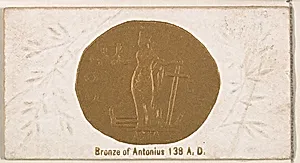
Bronze of Antonius, 138 A.D., from the Ancient Coins series (N180) issued by Wm. S. Kimball & Co.
Medium
Commercial color lithograph
Dimensions
Sheet: 1 1/2 × 2 5/8 in. (3.8 × 6.7 cm)
Classification
Prints|Ephemera
Department
Drawings and Prints
Museum
Metropolitan Museum of Art, New York, NY
Credit
The Jefferson R. Burdick Collection, Gift of Jefferson R. Burdick
Accession Number
63.350.216.180.9
Rights
Public Domain
Tags
Art Historical Context
This charming commercial color lithograph, titled *Bronze of Antonius, 138 A.D.*, is a tiny gem from William S. Kimball & Company's "Ancient Coins series (N)," produced in 1888. just 1 1/2 × 2 5/8 inches, it was likely a collectible insert for Kimball's cigarette packs, part of a popular 19th-century trend where tobacco companies distributed educational trading cards to captivate smokers and spark numismatic interest. These ephemera cards brought the allure of ancient history into everyday life, reflecting America's growing fascination with classical antiquity amid the Gilded Age's collecting craze. The image faithfully reproduces a Roman bronze coin from 138 A.D., associated with Antonius—possibly Antoninus Pius, the emperor who succeeded Hadrian. Rendered in vibrant lithography, a pioneering color printing technique that allowed mass production of detailed, multi-hued illustrations, it highlights the coin's intricate portrait and inscriptions. Such cards democratized art and history, blending commercial savvy with scholarly appeal. Housed in the Metropolitan Museum of Art's Drawings and Prints department as part of the Jefferson R. Burdick Collection, this piece underscores ephemera's cultural role: disposable yet enduring artifacts that preserved visual records of the past for future generations. A delightful window into Victorian-era hobbies!
About the Artist
William S. Kimball & Company · 1850–1950
**William S. Kimball & Company**, a pioneering American tobacco manufacturer, was established in 1846 in Rochester, New York, by William S. Kimball and James C. Hart. The firm quickly grew into one of the city's largest employers, particularly of women, producing popular brands like Peerless chewing tobacco, Rigatta and Fireside smoking tobacco, and Vanity Fair cigarettes. Under Kimball's leadersh...