
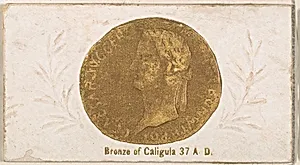
Bronze of Caligula, 37 A.D., from the Ancient Coins series (N180) issued by Wm. S. Kimball & Co.
Medium
Commercial color lithograph
Dimensions
Sheet: 1 1/2 × 2 5/8 in. (3.8 × 6.7 cm)
Classification
Prints|Ephemera
Department
Drawings and Prints
Museum
Metropolitan Museum of Art, New York, NY
Credit
The Jefferson R. Burdick Collection, Gift of Jefferson R. Burdick
Accession Number
63.350.216.180.22
Rights
Public Domain
Tags
Art Historical Context
Step into the captivating world of 19th ephemera with this diminutive commercial color lithograph, *Bronze of Calig, 37 A.D.*, produced by William S. Kimball Company in 1888. Part of the "Ancient Coins (N180)," this print (just 1 ½ × 2 ⅝ inches) was likely a collectible insert from Kimball's cigarette packs, sparking fascination among Victorian-era enthusiasts for classical antiquity. Housed in the Metropolitan Museum of Art's Drawings and Prints department, it comes from the renowned Jefferson R. Burdick Collection, a treasure trove of American ephemera. The image faithfully reproduces a bronze coin minted in 37 A.D., the inaugural year of Emperor Caligula's tumultuous reign (37–41 A.D.). Caligula, whose profile dominates the obverse, embodies the drama of Roman imperial portraiture—sharp features and laurel wreath symbolizing divinity and power. These coins circulated widely in the empire, serving as propaganda tools that blended artistry with politics. Crafted via chromolithography—a vibrant printing technique that layered colors for vivid realism—this piece highlights the era's commercial artistry. It bridged ancient history with Gilded Age popular culture, making Roman numismatics accessible to everyday collectors and fueling a craze for "cabinet cards" of the past. A delightful snapshot of how the classical world endured in modern pockets!
About the Artist
William S. Kimball & Company · 1850–1950
**William S. Kimball & Company**, a pioneering American tobacco manufacturer, was established in 1846 in Rochester, New York, by William S. Kimball and James C. Hart. The firm quickly grew into one of the city's largest employers, particularly of women, producing popular brands like Peerless chewing tobacco, Rigatta and Fireside smoking tobacco, and Vanity Fair cigarettes. Under Kimball's leadersh...