
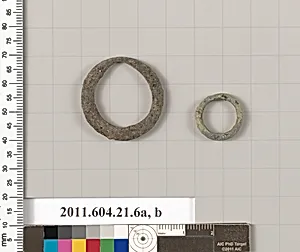
Bronze rings
Unknown Artist
6th/5th centuries BCE
Medium
Bronze
Classification
Bronzes
Period
Archaic/Classical
Department
Greek and Roman Art
Museum
Metropolitan Museum of Art, New York, NY
Credit
Gift of Dietrich von Bothmer, Distinguished Research Curator, Greek and Roman Art, 2011
Accession Number
2011.604.21.6a, b
Rights
Public Domain
Art Historical Context
These elegant bronze rings, dating to the 6th or 5th century BCE hail from the Archaic and early Classical periods of ancient Greece—a transformative era when art shifted from rigid geometric forms to more naturalistic expressions of the human form and daily life. Crafted by an unknown artisan, these simple yet enduring objects exemplify the versatility of bronze, a prized alloy of copper and tin that Greek metalworkers mastered through lost-wax casting and hammering techniques. Lightweight and corrosion-resistant, bronze made such rings ideal for personal adornment, likely worn as finger rings or earrings by men and women alike. In Greek society, jewelry like these rings held cultural weight beyond mere decoration; they symbolized status, protected against evil, or served as seals for documents. Their survival into modern times speaks to bronze's durability, outlasting more fragile materials like gold leaf or textiles. Acquired as a gift from Dietrich von Bothmer, the Met's esteemed Greek and Roman curator, in 2011, these rings offer museum visitors a tangible link to the vibrant world of Archaic Greece, where craftsmanship reflected a burgeoning appreciation for refined simplicity.