
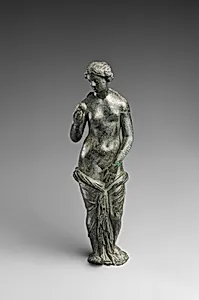
Bronze statuette of Aphrodite with silver eyes
Unknown Artist
3rd–1st century BCE
Medium
Bronze
Dimensions
H.: 8 1/4 in. (20.9 cm)
Classification
Bronzes
Culture & Period
Greek · Hellenistic
Department
Greek and Roman Art
Museum
Metropolitan Museum of Art, New York, NY
Credit
Bequest of Walter C. Baker, 1971
Accession Number
1972.118.96
Rights
Public Domain
Tags
Art Historical Context
This exquisite bronze statuette of Aph, the Greek goddess of love and beauty dates to the Hellenistic period (3rd–1st BCE). Standing just 8¼ inches tall, it captures the goddess in a graceful, contrapposto pose typical of Hellenistic art, which emphasized naturalism, emotion, and dynamic movement over the idealized restraint of earlier Classical styles. Crafted by an unknown artist, such small-scale bronzes were likely votive offerings for household shrines or sanctuaries, reflecting the era's blend of piety and personal devotion. The medium of bronze is particularly significant: hollow-cast using the lost-wax technique, these sculptures were prized for their durability and ability to convey subtle musculature and flowing drapery. The striking silver inlays for Aphrodite's eyes enhance her ethereal gaze, a rare technical flourish that imbues the figure with lifelike intensity and divine allure—few such inlaid bronzes survive, as many were melted down over centuries. Housed in the Metropolitan Museum of Art's Greek and Roman Art Department (Bequest of Walter C. Baker, 1971), this statuette offers a window into Hellenistic Greece's cultural reverence for Aphrodite, whose worship spanned eroticism, fertility, and maritime protection. It reminds us of an ancient world where beauty was both art and divinity.