
Bruchaesen. Etienne. 31 ans, né à Mag Levard (Hongrie). Tailleur d'habits. Anarchiste. 11/3/94.
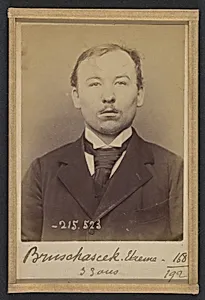
Medium
Albumen silver print from glass negative
Dimensions
10.5 x 7 x 0.5 cm (4 1/8 x 2 3/4 x 3/16 in.) each
Classification
Photographs
Department
Photographs
Museum
Metropolitan Museum of Art, New York, NY
Credit
Gilman Collection, Museum Purchase, 2005
Accession Number
2005.100.375.79
Rights
Public Domain
Tags
Art Historical Context
In the late 19th century, rising fears of anarchist violence in France, Alphonse Bertillon revolutionized criminal identification with his pioneering "anthropometric" system, known as bertillonnage. This 1894 albumen silver print from a glass negative Etienne Bruchaesen, 31-year-old tailor born in Magy Levard, Hungary, labeled simply as "Anarchiste on March 11. The small, precise portrait (10.5 7 cm) exemplifiesillon's standardized mugshot format—typically paired with a profile view—designed for meticulous police records, blending photography's objectivity with scientific measurement. Bertillon, as chief of the Paris Prefecture of Police's Identification Service, transformed forensic photography from mere documentation into a tool for tracking recidivists. The albumen process, using egg whites to bind light-sensitive silver salts on glass negatives, yielded sharp, detailed images ideal for such clinical purposes. This piece, from the Metropolitan Museum of Art's Gilman Collection, highlights photography's pivot from artistic portraiture to societal control during an era of political unrest, including bombings that gripped Paris. Today, Bruchaesen's stern gaze invites reflection on how images once confined to shadowy archives now illuminate history's undercurrents—reminding us of the human stories behind labels like "anarchist."
About the Artist
Alphonse Bertillon · 1853–1914
Alphonse Bertillon (1853–1914) was a pioneering French photographer whose work revolutionized forensic documentation, transforming police identification into a precise visual science. Born in Paris on April 22, 1853, he was the son of medical professor and statistician Louis-Adolphe Bertillon and the younger brother of demographer Jacques Bertillon. Lacking formal higher education after expulsion ...