
Brush Holder (Fude-zutsu)
Unknown Artist
1850–1920
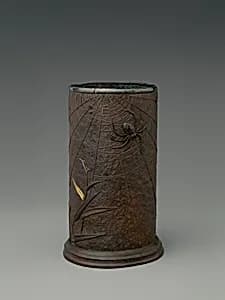
Medium
Cast iron with relief inlay in silver, gold and shibuichi
Dimensions
H. 6 3/4 in. (17.1 cm); Diam. of rim 3 3/8 in. (8.6 cm); Diam. of foot 4 in. (10.2 cm)
Classification
Metalwork
Culture & Period
Japan · Meiji period (1868–1912)
Department
Asian Art
Museum
Metropolitan Museum of Art, New York, NY
Credit
Edward C. Moore Collection, Bequest of Edward C. Moore, 1891
Accession Number
91.1.617
Rights
Public Domain
Tags
Art Historical Context
This elegant brush holder, or fude-zutsu, was created in Japan during the Meiji period (1868–1912), a time when traditional crafts flourished alongside rapid modernization. Produced between 1850 and 1920, the piece reflects the era’s emphasis on refined metalwork for the scholar’s desk, where calligraphy tools were both practical and objects of beauty. Its compact form—standing just under seven inches tall—would have held brushes upright, keeping them ready for use in daily writing or artistic practice. Crafted from cast iron with intricate relief inlays of silver, gold, and shibuichi (a copper-silver alloy), the holder demonstrates sophisticated Japanese metalworking techniques. The inlay process allowed artists to create delicate contrasts in color and texture, often depicting natural motifs. Here, spider designs add a subtle, symbolic layer, evoking themes of patience and creativity that resonate with the scholarly arts. Acquired by the Metropolitan Museum through the Edward C. Moore bequest in 1891, this work highlights the international appreciation for Meiji-period metalwork. Its blend of utility and artistry offers visitors a glimpse into the refined aesthetic of late nineteenth-century Japan.