
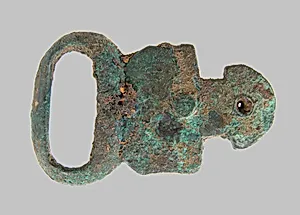
Buckle
Unknown Artist
500–725
Medium
Copper alloy
Dimensions
Overall: 1 7/16 x 7/8 x 3/16 in. (3.7 x 2.3 x 0.5 cm)
Classification
Metalwork-Copper alloy
Culture
Frankish
Department
Medieval Art
Museum
Metropolitan Museum of Art, New York, NY
Credit
Gift of J. Pierpont Morgan, 1917
Accession Number
17.193.297
Rights
Public Domain
Art Historical Context
This exquisite copper alloy buckle, crafted by an unknown Frankish artisan between 500 and 725 CE, offers a glimpse into the daily life and craftsmanship of the early Merian period. Measuring just 1 7/16 x 7/8 x 3/16 inches, this small metalwork object—likely used to fasten clothing or belts—was both functional and decorative, reflecting the Frankish people's blend of Germanic traditions and lingering Roman influences during Europe's turbulent Migration Age. Frankish culture flourished in what is now France and Germany under kings like Clovis I, who unified tribes and converted to Christianity. Metalwork like this buckle highlights the era's skilled metallurgy, with copper alloys favored for their durability and workability. Techniques such as casting and possibly incising or enameling (common in contemporary pieces) allowed for intricate designs symbolizing status and identity. Donated to the Metropolitan Museum of Art in 1917 by J. Pierpont Morgan, it exemplifies the artistry of a time when such personal adornments bridged pagan roots and emerging medieval Christianity. Today, this unassuming artifact reminds us how everyday objects preserved cultural heritage, inviting us to ponder the hands that fashioned it amid the fall of empires and rise of new worlds.