
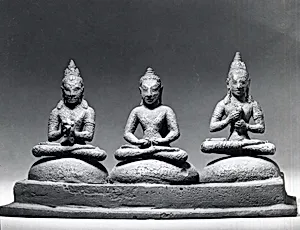
Buddhist Trinity on Cushions
Unknown Artist
8th century
Medium
Bronze
Dimensions
Gr. H. 4 1/16 in. (10.3 cm); L. 7 1/16 in. (17.9 cm)
Classification
Sculpture
Culture
Indonesia (Java, Dieng Plateau)
Department
Asian Art
Museum
Metropolitan Museum of Art, New York, NY
Credit
Samuel Eilenberg Collection, Gift of Samuel Eilenberg, 1987
Accession Number
1987.142.157
Rights
Public Domain
Tags
Art Historical Context
Nestled in the Metropolitan Museum of Art's Asian Art collection, *Buddhist Trinity onions* is a delicate 8th-century bronze sculpture Indonesia's Java, specifically the Dieng Plateau. just 4 1/16 inches high 7 1/16 inches long, this compact piece depicts a central Buddha flanked by two attendant figures—likely Bodhisattvas—seated serenely on lotus cushions. Crafted by an unknown artist, it the refined bronze casting techniques of the period, where the lost-wax method allowed for intricate details in drapery, serene expressions, and symbolic motifs. Originating from the Dieng Plateau, a highland site renowned for its cluster of ancient Hindu-Buddhist temples built around the 8th century, this sculpture reflects the early flourishing of Mahayana Buddhism in Java. During this era, maritime trade routes connected Java to India and Southeast Asia, spreading Buddhist iconography and artistic influences. The trinity composition symbolizes the harmonious unity of enlightenment, devotion, and protection, often used in personal shrines or temple altars. A gift from the Samuel Eilenberg Collection in 1987, this rare survivor offers a window into Javanese spiritual life, highlighting bronze's enduring appeal for portable devotional art. Its small scale invites intimate contemplation, bridging ancient rituals with modern admiration.