
Burnside Bridge, Across Antietam Creek, Maryland
September 1862
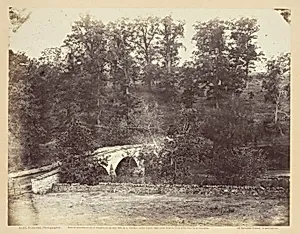
Medium
Albumen print, pl. 20 from the album "Gardner's Photographic Sketch Book of the War, vol. 1" (1866)
Dimensions
Image/paper: 17.8 × 22.9 cm (7 1/16 × 9 1/16 in.); Album page: 31.2 × 44.6 cm (12 5/16 × 17 9/16 in.)
Classification
photograph
Department
Photography and Media
Museum
Art Institute of Chicago
Accession Number
196184
Rights
Public Domain
Art Historical Context
Captured in September 1862 during the of the Battle of Antietam—the bloodiest single day in history, with over 22,000 casualties—Alexander's *Burnside Bridge, Across Antietam Creek, Maryland* offers a haunting glimpse into the Civil War's grim reality. This narrow stone bridge, named for Union General Ambrose Burnside, a deadly chokepoint where Federal troops endured devastating Confederate fire while attempting to cross the creek. Gardner, a Scottish-born photographer who had worked under Mathew Brady before leading his own team, arrived days after the clash to document the scarred landscape, bringing the war's devastation home to a Northern audience eager for unvarnished truth. Printed as plate 20 in Gardner's landmark 1866 album *Photographic Sketch Book of the War, Volume 1*, this albumen silver print exemplifies mid-19th-century photographic innovation. Albumen prints, made by coating paper with egg whites and sensitizing it with silver salts, produced richly toned images with exceptional detail, allowing viewers to scrutinize the bridge's weathered arches, scattered debris, and empty fields. At 17.8 × 22.9 cm, it's intimate yet immersive, underscoring photography's emerging power as a historical witness. Gardner's composition, with its stark horizontality and subtle shadows, conveys quiet desolation, elevating wartime documentation to fine art. Housed in the Art Institute of Chicago's Photography and Media department, this print remains a poignant testament to the human cost of conflict and the birth of photojournalism, inviting us to reflect on Antietam's pivotal role in Lincoln's Emancipation Proclamation.
About the Artist
Alexander Gardner · 1840–1882
Alexander Gardner was born on 17 October 1821 in Paisley, Renfrewshire, Scotland, and came of age in a culture shaped by radical social thought. Influenced by the cooperative ideals of Robert Owen, Gardner initially apprenticed as a jeweler and harbored dreams of founding a utopian community in America. His encounter with photography changed the course of his life. After seeing Mathew Brady's cele...