
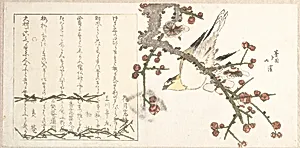
Bush Warbler on a Plum Branch (Ume ni uguisu)
early 19th century
Medium
Woodblock print (surimono); ink and color on paper
Dimensions
5 7/16 x 11 1/8 in. (13.8 x 28.3 cm)
Classification
Prints
Culture & Period
Japan · Edo period (1615–1868)
Department
Asian Art
Museum
Metropolitan Museum of Art, New York, NY
Credit
H. O. Havemeyer Collection, Bequest of Mrs. H. O. Havemeyer, 1929
Accession Number
JP2055
Tags
About this artwork
"Bush Warbler on a Plum Branch (Ume ni uguisu)" by Totoya Hokkei, created in early 19th century, is executed in woodblock print (surimono); ink and color on paper. This prints belongs to the Metropolitan Museum's Asian Art collection. The work measures 5 7/16 x 11 1/8 in. (13.8 x 28.3 cm). It originates from Japan, Edo period (1615–1868). The artwork entered the museum's collection through h. o. havemeyer collection, bequest of mrs. h. o. havemeyer, 1929.
Art Historical Context
In the early 19th century, Japan's Edo period (16151868), artist Totoya Hokkei crafted *Bush Warbler on a Plum Branch (Ume ni uguisu)* as a delicate woodblock print known as *surimono*. These intimate, privately commissioned works were prized for their refined craftsmanship, often produced in small editions for New Year's greetings or poetry gatherings. Measuring just 5 7/16 x 11 1/8 in. (13.8 x 28.3 cm), this ink and color on paper print exemplifies the ukiyo-e tradition's mastery of subtle gradients and vibrant hues, achieved through precise carving and multi-block printing techniques. The ...
About the Artist
Totoya Hokkei · 1780–1850
Totoya Hokkei (魚屋 北渓, 1780–1850), born Iwakubo Tatsuyuki in Edo (modern Tokyo), began his life as a humble fishmonger in the Yotsuya Samegahashi district, a trade reflected in his art name "Totoya," meaning fish shop. He transitioned to art through rigorous training, first studying under Kanō Yōsen'in Korenobu, head of the Kobikichō branch of the prestigious Kanō school, where he honed landscape p...