
Button
Late 18th century
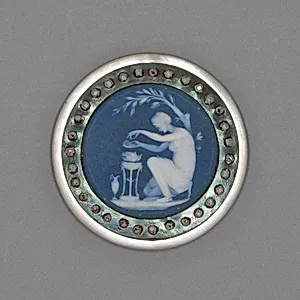
Medium
Stoneware (jasperware)
Dimensions
Diam.: 4.1 cm (1 5/8 in.)
Classification
accessories (object genre)
Department
Applied Arts of Europe
Museum
Art Institute of Chicago
Accession Number
68098
Rights
Public Domain
Art Historical Context
This exquisite button from the Wedgwood Manufactory, crafted in the late 18th century, exemplifies the pinnacle of British ceramic innovation during the Neoclassical era. Made of jasperware—a fine, unglazed stoneware developed by Josiah Wedgwood in the 1770s—the small disc (just 4.1 cm in diameter) features the signature matte blue body with raised white reliefs, mimicking the appearance of ancient Roman cameos and gemstones. Wedgwood's factory revolutionized pottery production, blending artistic refinement with industrial precision to create affordable luxury items. Jasperware's technique involved mixing barium sulfate into clay for a durable, gem-like translucency, then pressing finely detailed molds onto the surface before firing at high temperatures. This button, classified as an accessory in the Art Institute of Chicago's Applied Arts of Europe collection, highlights how Wedgwood elevated everyday objects into miniature sculptures, often adorned with classical motifs like gods, portraits, or floral designs inspired by archaeological discoveries at Pompeii and Herculaneum. Culturally, such buttons adorned the clothing of the Georgian elite, symbolizing taste and enlightenment values. Wedgwood's wares even graced Queen Charlotte's table, earning the royal warrant "Potter to Her Majesty." This unassuming piece invites us to appreciate the artistry in the functional, bridging ancient aesthetics with modern manufacturing.
About the Artist
Wedgwood Manufactory
Wedgwood Manufactory, founded on 1 May 1759 by Josiah Wedgwood in Burslem, Staffordshire, England, revolutionized ceramics during the Industrial Revolution. Born into a family of potters, Josiah apprenticed under his elder brother Thomas at the Churchyard Works from age 14, mastering traditional techniques before partnering with Thomas Whieldon from 1754 to 1759, where he honed innovative glazes. ...