
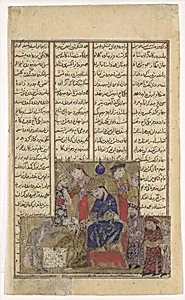
"Buzurjmihr Masters the Game of Chess", Folio from a Shahnama (Book of Kings)
ca. 1330–40
Medium
Ink, opaque watercolor, gold, and silver on paper
Dimensions
Entire Page: H. 8 1/16 (20.5 cm) W. 4 7/8 in. (12.4 cm) Painting: H. 3 1/8 in. (8 cm) W. 4 in. (10.2 cm) Mat: H. 19 1/4 in. (48.9 cm) W. 14 1/4 in. (36.2 cm) Frame: H. 22 in. (55.9 cm) W. 17 in. (43.2 cm)
Classification
Codices
Department
Islamic Art
Museum
Metropolitan Museum of Art, New York, NY
Credit
Bequest of Monroe C. Gutman, 1974
Accession Number
1974.290.39
Rights
Public Domain
Tags
Art Historical Context
This exquisite folio, titled "Buzurjmihr Masters the Game of Chess comes from an illustrated manuscript of the Shahnama (Book of Kings), the great Persian epic poem composed by Abu'l Qasim Firdausi around 1000 CE. Dating to approximately 1330–1340, the page captures a pivotal moment in the narrative where the wise vizier Buzurjmihr demonstrates his intellect by mastering the game of chess, a tale that underscores themes of knowledge, strategy, and cultural exchange between Persia and India. Created with ink, opaque watercolor, gold, and silver on paper, the miniature reflects the refined techniques of 14th-century Persian book arts. The luminous metallic accents and delicate brushwork bring vibrancy to the courtly scene, emphasizing the manuscript's status as both a literary treasure and a work of visual splendor. Such codices were often commissioned for royal or noble patrons, serving as symbols of cultural prestige. Housed in the Metropolitan Museum of Art’s Department of Islamic Art, this folio highlights the enduring legacy of Firdausi’s poetry. The depiction of kings and courtiers engaged in intellectual pursuit invites viewers to appreciate how art and literature intertwined to celebrate wisdom and storytelling in medieval Islamic societies.
About the Artist
Abu'l Qasim Firdausi · 935–1020
Abu'l Qasim Firdausi, born around 940 in the village of Paj near Tus in Khorasan (modern-day Iran), emerged from a family of landed gentry known as dehqans, who preserved ancient Iranian oral traditions amid the cultural renaissance of the Samanid Empire. Little is documented about his early life or formal training, though he likely received a basic education including Arabic literacy, immersing h...