
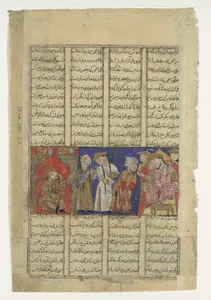
"Caesar Gives his Daughter Katayun to Gushtasp", Folio from a Shahnama (Book of Kings) of Firdausi
ca. 1330–40
Medium
Ink, opaque watercolor, gold, and silver on paper
Dimensions
Painting: H. 1 15/16 in. (4.9 cm) W. 4 3/16 in. (10.6 cm) Page: H. 8 1/16 in. (20.5 cm) W. 5 5/16 in. (13.5 cm) Mat: H. 19 1/4 in. (48.9 cm) W. 14 1/4 in. (36.2 cm)
Classification
Codices
Department
Islamic Art
Museum
Metropolitan Museum of Art, New York, NY
Credit
Bequest of Monroe C. Gutman, 1974
Accession Number
1974.290.22
Rights
Public Domain
Tags
Art Historical Context
This exquisite folio, titled *"Caesar Gives his Daughterayun to Gushtasp"*, comes from a *Shahnama* (Book of Kings), the epic by Abu'l Qasim Firda completed around 1010 CE. Dating to ca. 1330–40, it captures a pivotal moment in Persian mythology: the Byzantine emperor Caesar betrothing his daughter, the princess Katayun, to the Persian prince Gushtasp Such scenes blend history, legend, and romance, celebrating Iran's royal lineage in a narrative that spans pre-Islamic kings to the Arab conquest. Crafted in the tradition of Persian miniature painting, the artwork employs ink for precise outlines, vibrant opaque watercolors for rich hues, and lavish gold and silver for luminous highlights—techniques that evoke a sense of opulence in its compact format (painting just 1 15/16 x 4 3/16 inches). These codices, classified under Islamic Art, were luxury manuscripts produced for elite patrons, showcasing the era's masterful calligraphy and illustration during the Ilkhanid period under Mongol influence. Housed in the Metropolitan Museum of Art (Bequest of Monroe C. Gutman, 1974), this folio highlights the *Shahnama*'s enduring cultural role in preserving Persian identity, identity, poetry, and artistry. Visitors will appreciate how its depiction of princes, princesses, and attendants in flowing robes bridges ancient tales with timeless visual splendor.
About the Artist
Abu'l Qasim Firdausi · 935–1020
Abu'l Qasim Firdausi, born around 940 in the village of Paj near Tus in Khorasan (modern-day Iran), emerged from a family of landed gentry known as dehqans, who preserved ancient Iranian oral traditions amid the cultural renaissance of the Samanid Empire. Little is documented about his early life or formal training, though he likely received a basic education including Arabic literacy, immersing h...