
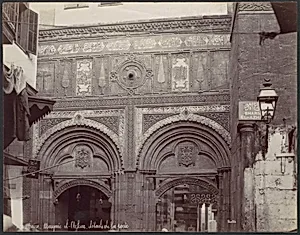
Caire. Mosquée el-Arhar, détails de la porte
1870s
Medium
Albumen silver print from glass negative
Classification
Photographs
Department
Photographs
Museum
Metropolitan Museum of Art, New York, NY
Credit
Gift of Mrs. John L. Swayze, 1981
Accession Number
1981.1194.5
Rights
Public Domain
Tags
Art Historical Context
Step into the intricate world of 19th-century Cairo with Félix Bonfils' *Caire. Mosquée elhar, détails de la* (Cairo. Al-Azhar Mosque, details of the door), an albumen silver from a glass negative created in the 1870s. This photograph captures the ornate doorway of Al-Azhar Mosque, one of the world's oldest universities and a cornerstone of Islamic scholarship founded in 970 CE. Bonfils, a French based in Beirut, specialized in documenting the architectural wonders of the Middle East, offering Western audiences vivid glimpses of Oriental splendor. Bonfils' work exemplifies the golden age of travel photography, where his studio produced thousands of images that shaped European perceptions of the "exotic" East. The albumen process, using egg whites to bind light-sensitive silver salts, yielded rich tonal contrasts and fine details, perfectly suited to highlighting the mosque's carved stonework, arabesques, and muqarnas vaulting—hallmarks of Fatimid and Mamluk architecture. Today, housed in the Metropolitan Museum of Art (gift of Mrs. John L. Swayze, 1981), this print preserves a moment in time, bridging cultures and centuries. It invites us to marvel at Al-Azhar's enduring role as a vibrant center of learning and worship, frozen forever in Bonfils' masterful lens.