
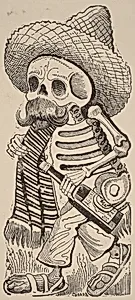
Calavera of Francisco Madero, from Calavera Maderista
1944 (printed)
Medium
relief etching (zinc) on China paper
Dimensions
sheet: 35.3 × 19.5 cm (13 7/8 × 7 11/16 in.)
Classification
Department
CG-E
Museum
National Gallery of Art, Washington, D.C.
Credit
Rosenwald Collection
Accession Number
1944.5.130
Rights
Public Domain
Art Historical Context
Behold the *Calavera of Francisco M, from Calavera Maderista*, striking zinc relief etching on delicate China paper by the legendary Mexican printmaker José Posada. Created during the turbulent Mexican Revolution and printed posthumously in 4, this small yet potent sheet (35.3 × 19.5 cm) Posada's signature style: bold, black-and-white skeletons that mock the powerful. Here, the skeletal figure of Francisco M—Mexico's revolutionary president assassinated in 1913—dances in satirical glee, embodying Posada's tradition of *calaveras*, humorous vignettes inspired by Day of the Dead imagery. Posada, a master of popular lithography and relief printing from the late 19th and early 20th centuries, used these prints in broadsheets to critique politicians, society, and death itself, making art accessible to the masses. His work profoundly influenced modern Mexican artists like Diego Rivera and became a cornerstone of national cultural identity. This piece, from the National Gallery of Art's Rosenwald Collection, highlights how Posada's zinc etchings—affordable and reproducible—spread biting social commentary amid revolutionary upheaval. The relief etching technique on thin China paper ensures crisp lines and fine detail, preserving Posada's dynamic energy even decades later. A timeless reminder of mortality and mockery, it invites visitors to reflect on power's fragility.
About the Artist
José Guadalupe Posada · 1852–1913
José Guadalupe Posada (1852-1913) was a Mexican printmaker and engraver who revolutionized popular art and created some of the most iconic images in Mexican culture. Working primarily with publisher Antonio Vanegas Arroyo, he produced over 20,000 images during his career—inexpensive broadsheets sold for a penny on colored paper that made his art accessible to even the poorest workers. He transform...