
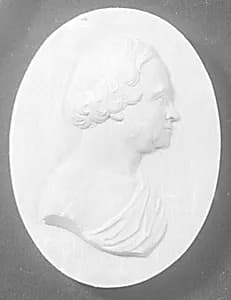
Cameo of a Gentleman
ca. 1850
Medium
Plaster
Dimensions
2 x 1 1/2 in. (5.1 x 3.8 cm)
Classification
Cameo
Culture
American
Department
The American Wing
Museum
Metropolitan Museum of Art, New York, NY
Credit
Gift of Dr. Clark S. Marlor, 1983
Accession Number
1983.519.3
Rights
Public Domain
Tags
Art Historical Context
**Cameo of a Gentleman by Erastus Dow Palmer created around 1850, is a finely detailed plaster relief portrait measuring just 2 x 1 1/2 inches. This intimate profile of an unidentified gentleman captures the neoclassical elegance popular in mid-19th-century America where artists drew inspiration from ancient Roman and Greek cameos to celebrate individual likenesses. Palmer, a self-ta sculptor from upstate New York, rose to prominence for his precise, miniature sculptures that blended classical restraint with Victorian portraiture's emotional depth. Crafted in plaster—a versatile medium often used for models before carving in marble—this cameo showcases Palmer's mastery of low-relief techniques, where the subject's sharp profile emerges dramatically against a contrasting background. Its small scale suggests it was designed as a personal keepsake, perhaps for jewelry or a locket, reflecting the era's growing middle-class appetite for affordable, customized art. Housed in The Metropolitan Museum of Art's American Wing as a gift from Dr. Clark S. Marlor in 1983, this work highlights the evolution of American sculpture during a time of national expansion and cultural aspiration. Palmer's cameos bridged European traditions with homegrown innovation, making classical forms accessible and deeply personal.