
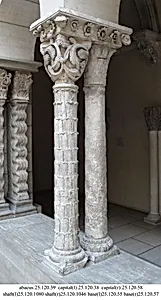
Capital
Unknown Artist
late 12th century
Medium
Stone
Dimensions
Overall: 10 x 8 5/8 x 8 5/8 in. (25.4 x 21.9 x 21.9 cm)
Classification
Sculpture-Architectural
Culture
French
Department
The Cloisters
Museum
Metropolitan Museum of Art, New York, NY
Credit
The Cloisters Collection, 1925
Accession Number
25.120.58
Rights
Public Domain
Art Historical Context
This exquisite stone capital, crafted by an unknown French artist in the late 12th, exemplifies the architectural artistry of medieval Europe. Measuring a compact 10 x 8⅝ x 8⅝ inches, it served as the crowning element of a column, supporting arches in grand cathedrals, cloisters, or abbeys As part of The Cloisters at The Metropolitan Museum of Art since 1925, it visitors to an era when stone masons transformed raw limestone into symbols of faith and beauty. Dating to the cusp of the Gothic period, this capital reflects the technical prowess of French sculptors who mastered high-relief carving to create dynamic surfaces. These architectural sculptures often featured intricate motifs—foliage, figures, or biblical scenes—that drew the eye upward, enhancing the spiritual drama of sacred spaces. Its survival speaks to the enduring legacy of Romanesque traditions evolving into Gothic innovation, where decoration became more naturalistic and expressive. Housed in The Cloisters, a branch devoted to medieval art, this piece invites you to ponder the anonymous hands that shaped it amid the bustling workshops of 12th-century France. A testament to craftsmanship without fame, it reminds us how everyday architectural elements elevated entire buildings into works of divine art.