
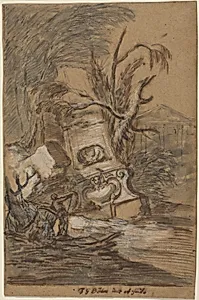
Capriccio with Antique Ruins
1730s
Medium
pen and brown ink, brush and gray ink, and gray wash over black chalk, heightened with white on brown wove paper
Dimensions
overall: 41.4 x 27 cm (16 5/16 x 10 5/8 in.)
Classification
Drawing
Department
CG-E
Museum
National Gallery of Art, Washington, D.C.
Credit
Ailsa Mellon Bruce Fund
Accession Number
1996.148.1
Rights
Public Domain
Art Historical Context
Created in the 1730s, Johann George Böhm’s *Capriccio with Antique Ruins* invites viewers into an imagined landscape where fragments of classical architecture stand in poetic disarray. The term “capriccio” refers to a fanciful composition that blends real and invented elements, a genre especially popular in eighteenth-century Europe as travelers on the Grand Tour developed a taste for evocative scenes of antiquity. Böhm’s drawing captures this spirit, offering a romantic meditation on the passage of time through crumbling columns, arches, and pediments that never existed together in reality. Executed in pen and brown ink with gray wash over black chalk, heightened with white on warm brown paper, the work demonstrates the artist’s skillful manipulation of light and shadow. The brown support provides a rich mid-tone that allows the white highlights to suggest sunlight striking weathered stone, while the layered washes create atmospheric depth. Measuring just over 16 by 10 inches, the sheet is intimate yet richly detailed, typical of drawings made both as independent works of art and as designs for prints or paintings. Today in the collection of the National Gallery of Art, this drawing reflects the period’s widespread fascination with classical heritage and the emerging Romantic sensibility that would later define much of nineteenth-century art.