
Carceri d'invenzione
Medium
etching
Dimensions
406; 550
Rights
Public Domain
About this artwork
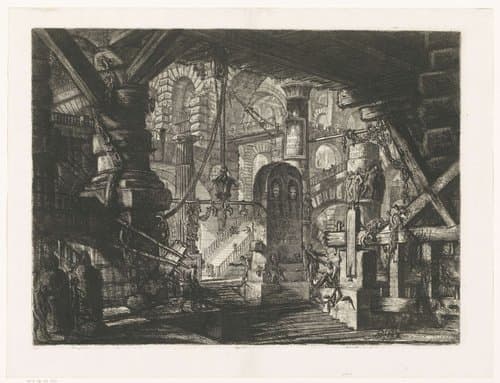
Gezicht in een monumentale ruimte (in de literatuur een pier genoemd) met veel trappen, kettingen en bogen. Links een grote pilaar en een lamp hangend aan een katrol in het midden. Genummerd rechtsonder: XVI.
Art Historical Context
### Giovanni Battista Piranesi's *Carceri d'Invenzione, Plate XVI* (1761) Step into the shadowy depths of Giovanni Battista Piranesi *Carceri d'Invenzione* (Imaginary Prisons), a series of etchings that transport viewers to vast, labyrinthine dungeons of the imagination. This 1761 edition, Plate, captures a monumental pier-like space teeming with endless staircases twisting into obscurity, dangling chains, soaring arches, a massive pillar on the left, and a solitary lamp suspended from a central pulley—evoking both grandeur and confinement. Measuring 406 × 550 mm, the etching draws you into an architectural fever dream, where perspective warps reality. Piranesi, an 18th-century Italian artist and architect (1720–1778), revolutionized printmaking with his vedute (topographical views) of Rome, but the *Carceri*—first etched around 1745 and refined in later editions—reveal his flair for the fantastical. As a master etcher, he layered ink and burin strokes to achieve dramatic chiaroscuro, creating impossible depths and textures that mimic stone's weight. These works bridged Baroque exuberance and emerging Romanticism, symbolizing the Enlightenment's awe of ruins and the sublime terror of boundless space. Culturally, the *Carceri* captivated intellectuals like Goethe, influencing later movements from Surrealism to modern architecture. They invite us to ponder human ambition's dizzying heights—and precarious falls—in a single, haunting glance.
About the Artist
Giovanni Battista Piranesi · 1720–1778
Giovanni Battista Piranesi (1720–1778) was an Italian printmaker, architect, and antiquarian whose visionary etchings of Rome and imaginary prisons revolutionized architectural representation and profoundly influenced both Neoclassicism and Romanticism. Piranesi stands as one of the most important printmakers of the eighteenth century, fundamentally shaping European perceptions of ancient Rome an...