
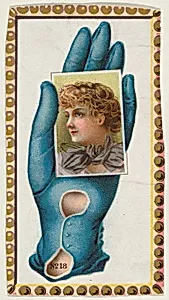
Card Number 18, cut-out from banner advertising the Opera Gloves series (G29) for Allen & Ginter Cigarettes
Medium
Commercial color lithograph
Dimensions
Sheet: 3 1/8 x 1 3/4 in. (8 x 4.5 cm)
Classification
Prints|Ephemera
Department
Drawings and Prints
Museum
Metropolitan Museum of Art, New York, NY
Credit
The Jefferson R. Burdick Collection, Gift of Jefferson R. Burdick
Accession Number
63.350.202.29.18
Rights
Public Domain
Tags
Art Historical Context
Step into the vibrant world of 1890s advertising with *Card Number 18*, tiny cut-out from a banner promoting Allen & Ginter's Opera series (G29) cigarette inserts. Produced around 1890 by the pioneering American Tobacco Company, this commercial color lithograph measures just 3 1/8 x 1 3/4 inches, designed as collectible ephemera to smokers and fashion enthusiasts alike. Allen & Ginter revolutionized tobacco marketing by embedding colorful trade cards in cigarette packs, sparking a collecting craze that predated modern trading cards. This piece highlights the elegance of opera gloves—a staple of high-society women's attire—blending fashion illustration with bold promotion. Chromolithography, the era's cutting-edge technique, allowed for vivid, mass-produced colors that mimicked fine art while driving consumer desire. Housed in the Metropolitan Museum of Art's Jefferson R. Burdick Collection, this delicate print offers a glimpse into Gilded Age commerce, where luxury accessories like gloves symbolized femininity and status. A charming survivor of everyday extravagance, it reminds us how advertising wove art into the fabric of daily life.
About the Artist
Allen & Ginter|American Tobacco Company
Allen & Ginter, the pioneering American tobacco firm based in Richmond, Virginia, emerged around 1880 from the partnership of John F. Allen and Lewis Ginter, evolving from Allen's earlier John F. Allen & Company. Allen retired in 1882, succeeded by John Pope, yet the brand endured under Ginter's leadership, employing over 1,100 workers—mostly women—for hand-rolled cigarettes by 1886. Ginter, a Dut...