
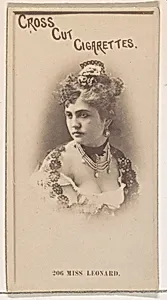
Card Number 206, Miss Leonard, from the Actors and Actresses series (N145-2) issued by Duke Sons & Co. to promote Cross Cut Cigarettes
1880s
Medium
Albumen photograph
Dimensions
Sheet: 2 5/8 × 1 7/16 in. (6.6 × 3.7 cm)
Classification
Photographs|Ephemera
Department
Drawings and Prints
Museum
Metropolitan Museum of Art, New York, NY
Credit
The Jefferson R. Burdick Collection, Gift of Jefferson R. Burdick
Accession Number
63.350.207.145.2.206
Rights
Public Domain
Tags
Art Historical Context
In the bustling world of late 19th-century America, tobacco companies like W. Duke, Sons & Co. revolutionized marketing with collectible trading cards tucked into cigarette packs. This diminutive albumen photograph, *Card Number 206, Miss Leonard*, from the Actors and Actresses series (145-2) promoting Cross Cut Cigarettes, the era's fascination with theater stars. Issued in the 1880s, it features a poised portrait of actress Miss Leonard, her image rendered in exquisite detail on a tiny sheet measuring just 2 5/8 × 1 7/16 inches—perfect for album collectors or pocket-sized admiration. Albumen prints, the dominant photographic medium of the time, used egg white-coated paper to produce sharp, luminous images with a signature warm tone, making these cards both affordable and visually striking. As ephemera, they bridged advertising and popular culture, glamorizing actresses amid Victorian society's mix of propriety and stage allure. These cards fueled a collecting craze, reflecting the rise of celebrity and consumer branding before modern regulations. Today, this card resides in the Metropolitan Museum of Art's Jefferson R. Burdick Collection, a treasure trove of over 30,000 American prints and ephemera gifted in 1948. It offers a window into how everyday indulgences like cigarettes intertwined with entertainment, reminding us of advertising's artistic roots.
About the Artist
W. Duke, Sons & Co. · 1870–1920
**W. Duke, Sons & Co.: Pioneers of Chromolithographic Trade Card Art** W. Duke, Sons & Co., an American tobacco manufacturer, emerged from the entrepreneurial vision of Washington Duke (1820–1905) and his sons in Durham, North Carolina. After the Civil War, Washington abandoned farming in 1874 to join his eldest son, Brodie L. Duke, in the burgeoning tobacco trade, establishing a factory that for...