
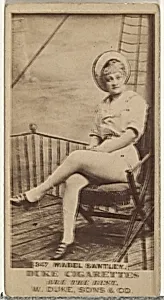
Card Number 347, Mabel Santley, from the Actors and Actresses series (N145-7) issued by Duke Sons & Co. to promote Duke Cigarettes
1880s
Medium
Albumen photograph
Dimensions
Sheet: 2 11/16 × 1 3/8 in. (6.8 × 3.5 cm)
Classification
Photographs|Ephemera
Department
Drawings and Prints
Museum
Metropolitan Museum of Art, New York, NY
Credit
The Jefferson R. Burdick Collection, Gift of Jefferson R. Burdick
Accession Number
63.350.208.145.7.160
Rights
Public Domain
Tags
Art Historical Context
Step into the vibrant world of 1880s advertising with *Card Number 347, Mabel Santley*, a charming albumen photograph from the Actors and Actresses series (N145-7), issued by W. Duke, & Co. to promote their Duke Cigarettes. This portrait (just 2 11/16 × 1 3/8 inches) captures the poised elegance of British actress Mabel Santley, star of the Victorian stage known for her roles in light opera and comedy. Tucked into cigarette packs as collectible trade cards, these ephemera were a clever marketing ploy, turning smokers into avid collectors amid the Gilded Age's theater craze. Albumen prints, made by coating paper with egg whites and silver salts for sharp detail and warm tones, were the gold standard for photography in the era, bridging fine art and mass production. Here, the medium's clarity highlights Santley's expressive features, transforming a commercial gimmick into a snapshot of celebrity culture. Part of the Metropolitan Museum of Art's Jefferson R. Burdick Collection—a treasure trove of printed ephemera gifted in 1948—this card reveals how tobacco giants like Duke pioneered modern branding, blending portraiture with consumer allure. Today, it whispers of women's rising visibility in entertainment and the democratizing power of collectibles, inviting us to ponder the stars who lit up both stages and parlors.
About the Artist
W. Duke, Sons & Co. · 1870–1920
**W. Duke, Sons & Co.: Pioneers of Chromolithographic Trade Card Art** W. Duke, Sons & Co., an American tobacco manufacturer, emerged from the entrepreneurial vision of Washington Duke (1820–1905) and his sons in Durham, North Carolina. After the Civil War, Washington abandoned farming in 1874 to join his eldest son, Brodie L. Duke, in the burgeoning tobacco trade, establishing a factory that for...