
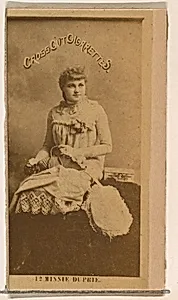
Card Number 42, Minnie Dupree, from the Actors and Actresses series (N145-2) issued by Duke Sons & Co. to promote Cross Cut Cigarettes
1880s
Medium
Albumen photograph
Dimensions
Sheet: 2 5/8 × 1 7/16 in. (6.6 × 3.7 cm)
Classification
Photographs|Ephemera
Department
Drawings and Prints
Museum
Metropolitan Museum of Art, New York, NY
Credit
The Jefferson R. Burdick Collection, Gift of Jefferson R. Burdick
Accession Number
63.350.207.145.2.85
Rights
Public Domain
Tags
Art Historical Context
In the late 1880s, American tobacco companies like W. Duke, Sons & Co. revolutionized advertising with collectible cigarette cards, tiny treasures inserted into packs of Cross Cut Cigarettes. This *Card Number 42, Dupree*, from the Actors and Actresses seriesN145-2), the era's fascination with theater stars. Featuring portrait actress Minnie Dupree, it exemplifies how ephemera bridged commerce and culture, enticing smokers—especially young collectors—with glamorous images of performers. Printed as a miniature albumen photograph (2 5/8 × 1 7/16 in.), the card showcases the medium's hallmark warm tones and fine detail, achieved by coating paper with egg whites sensitized to silver salts. Though mass-produced, these cards preserved vivid likenesses of women like Dupree, who embodied the rising visibility of female actors on stage amid Victorian America's booming entertainment scene. Today, housed in the Metropolitan Museum of Art's Jefferson R. Burdick Collection, this piece highlights ephemera's role in social history. It reflects early celebrity culture, gender dynamics in the arts, and the tobacco industry's clever marketing, transforming a promotional gimmick into a cherished artifact of 19th-century life.
About the Artist
W. Duke, Sons & Co. · 1870–1920
**W. Duke, Sons & Co.: Pioneers of Chromolithographic Trade Card Art** W. Duke, Sons & Co., an American tobacco manufacturer, emerged from the entrepreneurial vision of Washington Duke (1820–1905) and his sons in Durham, North Carolina. After the Civil War, Washington abandoned farming in 1874 to join his eldest son, Brodie L. Duke, in the burgeoning tobacco trade, establishing a factory that for...