
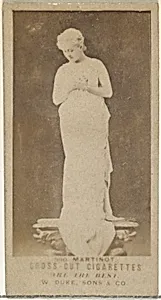
Card Number 590, Sadie Martinot, from the Actors and Actresses series (N145-3) issued by Duke Sons & Co. to promote Cross Cut Cigarettes
1880s
Medium
Albumen photograph
Dimensions
Sheet: 2 11/16 × 1 3/8 in. (6.8 × 3.5 cm)
Classification
Photographs|Ephemera
Department
Drawings and Prints
Museum
Metropolitan Museum of Art, New York, NY
Credit
The Jefferson R. Burdick Collection, Gift of Jefferson R. Burdick
Accession Number
63.350.208.145.3.124
Rights
Public Domain
Tags
Art Historical Context
In the late 1880s, American tobacco companies like W., Sons & Co. revolutionized with colorful trading cards tucked into cigarette packs, sparking a collecting craze among all ages. This petite albumen photograph, *Card Number 590, Martinot*, from the *Actors and Actresses* series (145-3) promoting Cross Cut Cigarettes, the trend. Measuring just 2 11/16 × 1 3/8 inches, these ephemera cards featured celebrity portraits to glamorize smoking, blending commerce with pop culture. Sadie Martinot, a popular stage actress of the era, gazes confidently here, her image captured via the albumen process—a pioneering 19th-century technique using egg whites for sharp, glossy prints ideal for mass reproduction. Part of the vast Jefferson R. Burdick Collection at The Metropolitan Museum of Art, this card highlights women's rising visibility in theater and media, even as promotional tools for a male-dominated habit. Today, these cards offer a window into Gilded Age celebrity worship and marketing ingenuity, transforming everyday consumers into avid collectors while preserving fleeting moments of fame.
About the Artist
W. Duke, Sons & Co. · 1870–1920
**W. Duke, Sons & Co.: Pioneers of Chromolithographic Trade Card Art** W. Duke, Sons & Co., an American tobacco manufacturer, emerged from the entrepreneurial vision of Washington Duke (1820–1905) and his sons in Durham, North Carolina. After the Civil War, Washington abandoned farming in 1874 to join his eldest son, Brodie L. Duke, in the burgeoning tobacco trade, establishing a factory that for...