
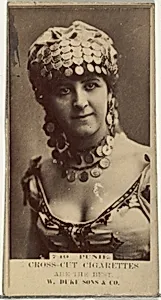
Card Number 719, Punie, from the Actors and Actresses series (N145-3) issued by Duke Sons & Co. to promote Cross Cut Cigarettes
1880s
Medium
Albumen photograph
Dimensions
Sheet: 2 11/16 × 1 3/8 in. (6.8 × 3.5 cm)
Classification
Photographs|Ephemera
Department
Drawings and Prints
Museum
Metropolitan Museum of Art, New York, NY
Credit
The Jefferson R. Burdick Collection, Gift of Jefferson R. Burdick
Accession Number
63.350.208.145.3.141
Rights
Public Domain
Tags
Art Historical Context
Step into the vibrant world of 1880s advertising with *Card Number 719,ie, from the Actors and Actresses series (145-3)*, a tiny gem produced by W. Duke, Sons & Co. to their Cross Cut Cigarettes. Thisible trade card features a portrait of the actress Punie, capturing her poised elegance in an albumen photograph—a popular 19th-century process using egg whites to create sharp, luminous prints on paper. Measuring just 2 11/16 × 1 3/8 inches, it was designed for pockets, scrapbooks, or albums, enthusiasts to trade and collect. Issued during a boom in tobacco marketing, these cards from Duke's series highlighted stage stars like Punie, blending celebrity culture with consumer promotion. Actresses embodied glamour and allure, drawing in buyers amid fierce competition among cigarette makers. As ephemera—short-lived promotional items—they offer a window into Gilded Age America, where photography met mass marketing. Today, housed in the Metropolitan Museum of Art's Jefferson R. Burdick Collection, this card underscores the artistry of everyday objects. Its precise portraiture and cultural snapshot remind us how 1880s innovations in printing and photography fueled modern advertising, turning actors into icons and cigarettes into collectibles.
About the Artist
W. Duke, Sons & Co. · 1870–1920
**W. Duke, Sons & Co.: Pioneers of Chromolithographic Trade Card Art** W. Duke, Sons & Co., an American tobacco manufacturer, emerged from the entrepreneurial vision of Washington Duke (1820–1905) and his sons in Durham, North Carolina. After the Civil War, Washington abandoned farming in 1874 to join his eldest son, Brodie L. Duke, in the burgeoning tobacco trade, establishing a factory that for...